Part 4 of the Local Spins series on the “AI Revolution in Music” spotlights the views of three West Michigan recording studio veterans — who argue that human interactions in music can’t be replicated.
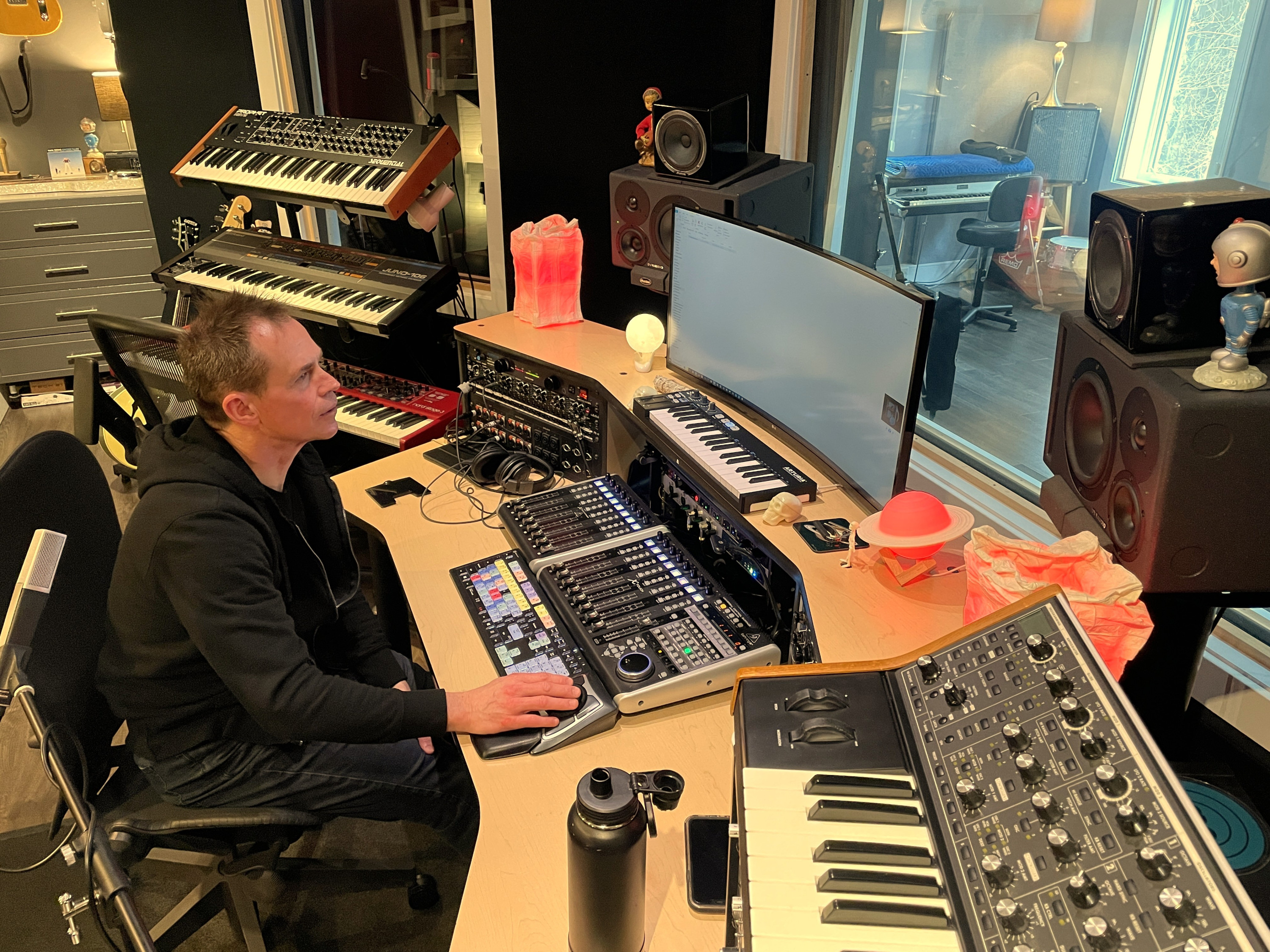
Joel Ferguson at Planet Sunday: “The human element will always be a big part of moving music forward.” (Photo/Local Spins)
“There are some things AI can’t do, like carry an amp on stage.”
Support our coverage of
West Michigan's music scene
“AI won’t create the next Billie Eilish, Kurt Cobain or Johnny Cash.”
Amid the hubbub, hand-wringing and industry upheaval surrounding the advent of artificial intelligence (AI) in music comes the simple and obvious counterpoint: Human interaction in the creative process and in live music production can’t be replicated.
A recent press release from an Alabama music officer and former marketing head for South by Southwest noted that “to make live music concerts a reality, you not only need real musicians, you need real people to soundcheck, produce light shows, carry equipment, etc. … The need for real people to make the magic of concerts come to life is irreplaceable.”
The same is true for musicians working together in the recording studio or collaborating on a song — bouncing ideas off one another, concocting something truly unique.
Granted, recording engineers say AI can be a valuable tool in many ways to aid that process or help artists market their work with this caveat: Always stay wary of the slippery slope that AI has become. Not only is it too easy to create fully produced songs — aka, “low-hanging fruit” — but some mainstream artists already complain that AI intruders are imitating their work and releasing “fake” songs under their name on Spotify and elsewhere.
In Part 4 of our series on the “AI Revolution in Music,” we asked three West Michigan recording experts for their views on the emerging technology: Joel Ferguson, owner of Rockford’s Planet Sunday Studios; Josh Kaufman, owner of Grand Rapids’ Local Legend Recording; and Austin Ruhstorfer, engineer at Grand Rapids’ River City Studios. And check out the rest of the series at Local Spins here.
Q: What’s your current assessment of AI and the biggest impact — or most obvious change — that this technology already has had on the music business?
Kaufman: AI in music technology is just the culmination of all music tools, from sheet music down to AutoTune. Ultimately, AI is just an accelerant of what already exists. I’m not on the bleeding edge of the technology day to day, so I’m more concerned with the artist level inspiration and how the industry can accommodate creators at all levels.
Ferguson: I think it’s been pretty useful for certain things, especially for beginners. Asking for mic positioning ideas and getting info on best practices for gain staging etc., it can be quite handy. It’s obviously better to have some knowledge so you can know when it’s wrong, which it occasionally is of course.
Ruhstorfer: One of the biggest impacts or obvious changes AI technology has had on music business is that it as massively democratized professional quality music creation without the human interaction and processes required in the past via “smart-plugins,” automated AI-leveraged mixing and mastering services, applications like SUNO, Splice, LANDR. Songwriting is also impacted as people can have Artificial Intelligence write and compose lyrics, chords, melodies, arrangements, full productions for them without really any prior knowledge, musical training or skill sets to do so. But it’s missing a key component to the whole “ball of wax” — the shared human experience and the sense memories and ideas and dreams of a human experience.

Josh Kaufman at Local Legend Recording (Photo/Local Spins)
Q: Has the advent of AI altered what you do as a studio engineer/producer?
Ferguson: Not in any radical unexpected way. It’s just become another tool in the kit.
Kaufman: I use computers only as capture devices and am actively trying to find ways to not be on the computer. The clients I work with don’t have a strong need for AI as a creation tool, however I suspect promotion, booking, emails, all the business stuff can be replaced by AI which may help those without representation in a small way. Organization of the business side will be streamlined.
Ruhstorfer: There are some new tools available that are interesting to deploy and use when the need comes or a project calls for it, but I’m mainly producing, engineering, mixing as I always have. AI hasn’t replaced me or what I do as a music producer. Many artists still need and utilize music producers to collaborate with in the way they always have, similar to how a professional athlete utilizes a coach or mentor often to help “tweak” them vs. doing all the work for them. I generally still go off instinct, my knowledge of recording techniques, microphones, processing, my personal tastes and experience to create and enhance the art form of recorded music.
Q: Are you worried about the future of studio recording and your business because of AI’s rapid emergence?
Kaufman: I don’t worry for the studio business, but for the point of inspiration. AI is a point on a trajectory, and it makes getting to a result easier. I wonder if the magic is somewhere between the spark and the fanning of the flame, with AI being gasoline. I’ve seen what contemplative thought, struggle, spontaneity, restriction, time, interplay with other voices can do to a spark of inspiration, and I worry that the pursuit of a result, and a result that is more and more playable, will offer an uncanny valley of result that will be good enough for some.
Ferguson: I think that it’s comparable to any new technology. It will certainly be easier for anyone, even if they don’t know much about music/theory to be able to create a song that is mixed and mastered in the blink of an eye. It might even be a really good song. But the human element will always be a big part of moving music forward. I just believe that it’s another tool we now have at our disposal. When drum machines first started to emerge, most drummers were thinking it was awful and yet it became a tool even the best drummers learned to not only live with, but utilize for loop creations and textures that weren’t possible before.
Ruhstorfer: Not so much, because the people who are utilizing AI to game the system and essentially reach a satisfactory result without doing any of the work, resource expense, or be on the journey of creating a work of art, were generally never the clientele who would seek out a professionally equipped recoding studio and staff of collaborators in the first place. I think people who are motivated by the capabilities of AI in the music-sphere, are often the same types of people who weren’t necessarily interested in the art-form of music & audio production in the first place. In the end the results are pretty much all the same, too. “All sizzle, no steak.”
Q: Should consumers and listeners be concerned and wary of music that they hear and embrace amid this new environment?
Kaufman: Yes, I’d be concerned, and very strongly consider the source of where my music is coming from.
Ruhstorfer: I don’t know if they should be concerned, but definitely aware because generally people want to be moved, or feel something emotionally from the music they listen to and like. People like to be impressed by their artists and the music they spend time with. There’s nothing impressive about AI-generated art and music. Plain and simple. That’s always been the invisible contract between artist and fan/listener. Something still needs to be exchanged in the transaction between the artist’s music and the listener’s experience. And, when that human element is removed from the equation, and there isn’t a human behind the craft and experience in the transaction, the shared relationship between artist and audience is like … even less. AI is here and it’s not going away. Society as a collective will ultimately decide its place in art. I personally don’t think it will occupy as much space as the tech companies who produce this technology hope and predict. AI music and AI-assisted art is currently low-hanging fruit, and it will remain as such, in my opinion.
Ferguson: This reminds me of era changes like when rock ‘n’ roll came into the picture and classical musicians started to freak out because they started losing jobs or when grunge took over hair metal. There will always be progression and we’ve always been moving in a new direction. I don’t think this is any different. Embrace the parts that work for you. Put your spin on it. Use it to make something no one has ever heard before. Someone will. It certainly will be a part of music moving forward.
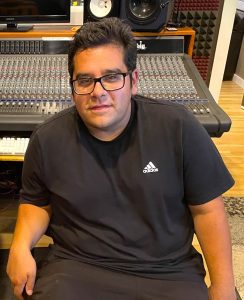
Austin Ruhstorfer (Photo/Local Spins)
Q: How should musicians, songwriters and creators approach this new reality — and best compete in an already saturated market?
Ruhstorfer: The biggest thing musicians, songwriters, performers, producers should focus on right now is going back to building legitimate fan bases, putting out quality music for a target audience vs “content” and “quantity.” You cannot have a career by just having an impressive number of views on a particular music video, or you have 100,000 followers on social media. Social media followers and YouTube views alone don’t translate in the real world. I personally know artists who have 300,000 followers, a million followers, YouTube video views in the millions, and they can’t sell 10,000 hard copies or downloads of an album. They can’t sell out a 450-cap venue anywhere in the United States. They aren’t generating any real money or success. It’s all a posture. Focus on cultivating 10,000 super-fans around the globe who would be willing to spend $100 a year on your music and career offerings. Whether that’s an LP vinyl, CDs, tickets for shows to see you to perform live, quality merchandise, T-shirts, etc. That’s a career that translates and means something in the real world to the artist and to the fan.
Ferguson: Keep making music from the heart. The entire AI platform is built on what HAS been. Therefore, it’s eternally open to what could be. The best artists are incredible dreamers who thrive on creation and who bring their own personalities into their craft.
Kaufman: Humanity is the commodity, work on the first part.
Q: Using AI is remarkably intoxicating for a musician. To test it, I recently used the Suno / AI Music site — feeding it lyrics and a basic melody played on piano while choosing various musical styles/genres. Within minutes it had spit out fully produced songs. Have you tested any of these AI formats, and if so, what’s your impression?
Kaufman: They sound silly now, they will be impressive soon. The tools will get better, who is using them, and why, is all that matters.
Ferguson: I haven’t personally done this, but I’ve heard many results of others who have. Sometimes it’s really interesting and sometimes it just falls flat. Again, I think it has a use for creating some maps of what’s worked in the past but it probably won’t create the next Billie Eilish, Kurt Cobain or Johnny Cash. Those are deeply personal artists and those types of artists, who are sharing their lived experience as a human being will always connect more with music lovers and outshine a data miner any day of the week.
Ruhstorfer: I’ve had some fun playing with some of the AI apps and offerings out there and they held my interest for a few minutes on a novelty level, but not much more than that. It was basically variations of the same slop that came out the other end. It still sounded derivative of the models it’s trained on and the prompts I gave it. To my experienced and trained ear, I can still hear the sub-par creativity in the results, and the predictability in the results. Will that change and will it get better? Sure. It probably already has since this interview. But again, it doesn’t land with me on any deeper level than a superficial one.
Copyright 2025, Spins on Music LLC