Part 3 of our series on the fast-emerging dominance of AI in the music businesses spotlights Kalamazoo studio owner Ian Gorman who warns that removing the ‘human element’ from music has dire repercussions.
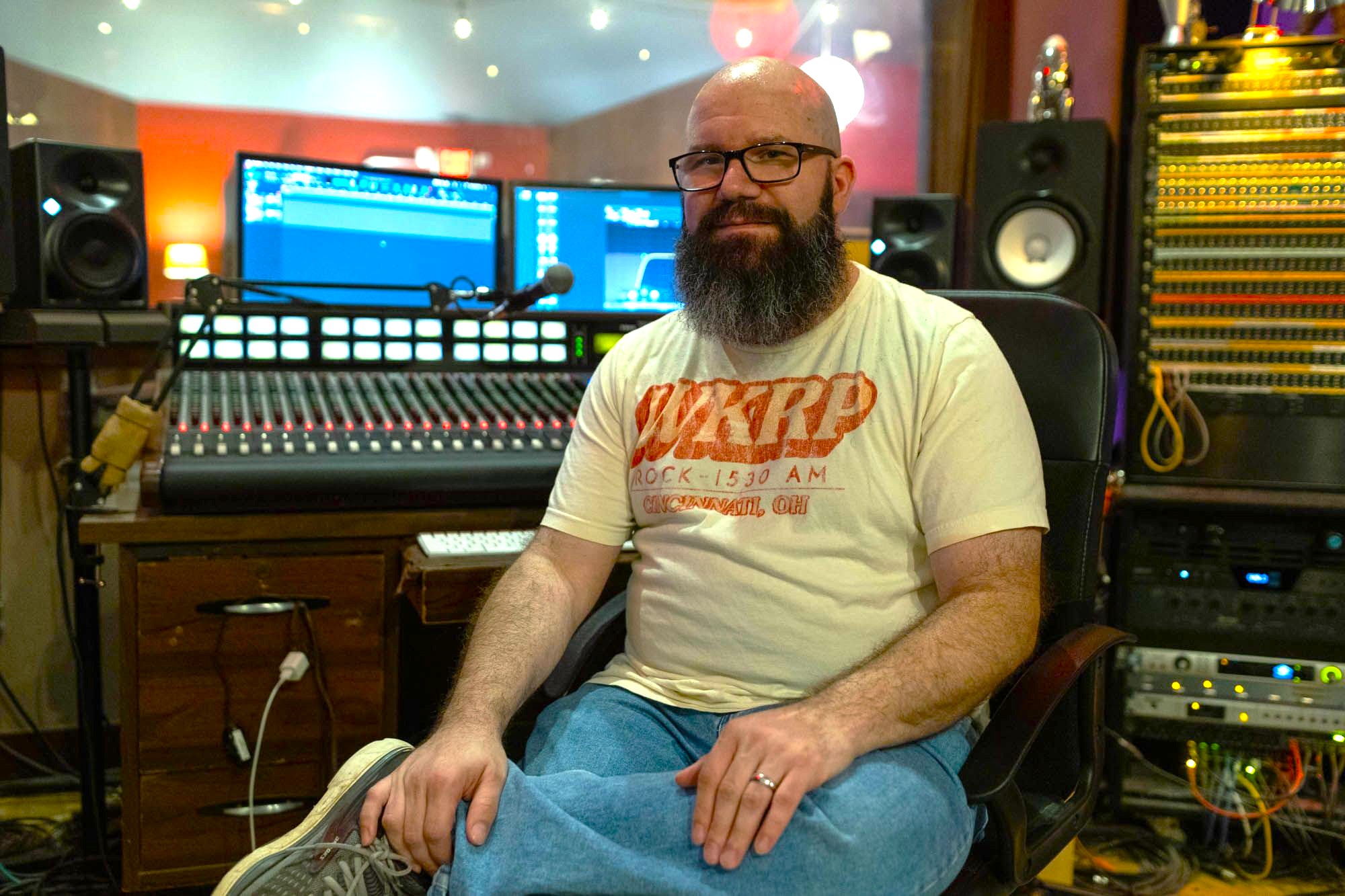
Ian Gorman at La Luna: Creating art on musicians’ own terms while weathering the AI assault. (Photo/Derek Ketchum)
READ PARTS 1 & 2 OF LOCAL SPINS’ SERIES: ‘AI IN MUSIC’
Support our coverage of
West Michigan's music scene
Not surprisingly, AI has become the biggest story in music over the past year.
Billboard magazine noted in its December tech report that it’s soared to the forefront in the industry, dominating fundraising, sparking lawsuits and legislation, and infiltrating “writing rooms” and record labels.
That’s because the speed and power of AI seems to have no bounds. Just like the experiment that Local Spins tried with creating a fully produced song with Suno AI Music for Part 1 of this “AI in Music” series, a recent “CBS Saturday Morning” broadcast demonstrated just how fast and easy it can be to uncork a fake-but-slick-and-impressive new track. (Scroll down to view the video.)
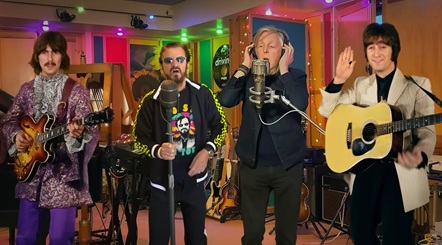
The Band is Back Together Again: The AI Beatles in the ‘Now and Then’ video
It’s clear that this technology has upset the music business apple cart, with hundreds of thousands of AI-generated songs now streaming on services across the globe. Of course, this troubles and bewilders many songwriters, musicians and producers who’ve embraced their own creativity and interactions to create original music. Might that now get lost amid this new flood of artificial art?
As with any emerging technology, the benefits of AI have merit, too. Even The Beatles used AI to enhance and isolate the late John Lennon’s vocals from a demo tape to create the 2023 single, “Now and Then.” That sort of tool also was used by studio owner and engineer Ian Gorman at Kalamazoo’s La Luna Recording & Sound to restore the sound on an old cassette tape brought in by a client.
But Gorman cautions that’s one of the few advantages of an AI assault on musical creativity and the livelihood of musicians. Here’s his take on AI in Part 3 of Local Spins’ in-depth report on “The AI Revolution in Music.” (Learn more about Gorman at Local Spins here.)
Q: What’s your current assessment of AI and the biggest impact — or most obvious change — that this technology already has had on the music business?
A: Generative AI is a major problem for both the present and the future of the music industry (and the creative world at large). It takes jobs away from musicians, and steals their work at the same time, all while being incredibly destructive to the environment. The last thing artists need is for an already-incredible-difficult life path to become even harder for them. I’m lucky enough to work and live within a community of musicians who still greatly value the human element and organic foundation of music, and are generally very anti-generative-AI. But the changes are obvious, on the fringes of my anti-AI bubble. Of course, generative AI music is greatly shunned among pretty much every musician and local music fan I know, but unfortunately that’s a relatively small part of the population. The reality is that there’s a lot of people out in the world to whom music and art aren’t a necessary and critical life-blood like it is to many of us here in the independent music scene. To a lot of folks, music plays a more background/mood-setting kind of role, and I don’t think they have the same ethical concerns about it as many of us. I think as AI music becomes more and more normalized over time, the stigma against it will fade, and many people unfortunately won’t care if the music they’re listening to is made by humans or AI. I’m sure in the post-production world, particularly background music for TV shows, movies, advertising, etc., the use of AI-generated music will become quite normal. That’s a world that is often much more concerned about budgets than they are artistic value. That being said, though, I think there will always be a strong contingent of music lovers who will be deeply dedicated to human-created music and art, and those are the kind of people I like to surround myself with and collaborate with.
Q: Has the advent of AI altered what you do as a studio engineer/producer?
A: Fortunately, AI-generated music hasn’t really been much of a factor at La Luna yet. The artists who work here are pretty solidly into the human element, as I am myself. My interest is in working with people and maintaining the organic, human element at the center of our art. That’s why I got into this. However, as anti-generative-AI as I am, I do think that non-generative-AI has useful benefits as a tool when used in a way that still supports the human element (rather than steals from it or replaces it). For instance, the AI-based technology in noise reduction/audio restoration is quite amazing. I’ve seen that technology used to help salvage important one-of-a-kind recordings. For instance, a client recently came to the studio with an old cassette of her now-deceased parents telling stories from their life. The recording was in incredibly poor quality, and hard to even make out what they were saying. With the use of some AI-based noise reduction tools, we were able to salvage the recordings to the point that she could clearly hear these stories. It was beautiful and touching. If that isn’t a pro-humanity result of using this technology as a tool for good, then I don’t know what is.
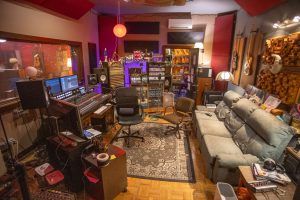
The Tools for Making Real Music: La Luna’s studio. (Photo/Derek Ketchum)
Q: Are you worried about the future of studio recording and your business because of AI’s rapid emergence?
A: I think it’s hard to tell how this is going to affect us in the future. Everything is changing so rapidly, and with technology, the rate of change keeps accelerating. I think it’s very possible the landscape of recording studios might look very different in a few years. And combined with the way the recording business has been gutted by streaming (and more specifically, artists’ income from their recorded work has been gutted by the insanely low payouts of streaming services, which has of course had significant effects throughout the entire industry), yes, I think the business is changing. This has always been a very challenging career path, and I think it’s getting harder by the day. It looks significantly different than it did when I started out, 30-plus years ago, and it’s just going to keep changing in ways we can’t even fathom yet. In addition to AI-generated music, there are AI-associated tools rising up that automate parts of the technical process (mastering specifically, but starting to enter the world of mixing as well). AI is also becoming more and more prevalent in the audiobook world (AI-generated voices reading scripts, that sort of thing). But as I said, a lot of artists I work with are still strongly attached to the human element. Just today, I had an author come in for an audiobook session because they had rejected their publisher’s AI-produced recording, and wanted to read it all themselves instead. But I think the next generation might not have the resistance to AI that many of us older folks have, and those walls are going to continue to break down. Am I worried about how AI will affect studios? Yes and no. I am worried about any change in technology that takes work away from people already struggling in a very difficult and competitive field, and I think that’s inevitable here. But on the other hand, I think as AI-technology rises, there will be an equally compelling backlash from artists and music fans, digging in even deeper into the human element. And regardless of what it does to the business, I think I will always have fellow artists to collaborate with that see eye-to-eye with me, and have similar values. I also think that change is inevitable, so it’s more about adapting to change, but that doesn’t mean you need to compromise your beliefs. It’s more about finding your own niche that fits your values and the way you want to live.
Q: Should consumers and listeners be concerned and wary of music that they hear and embrace amid this new environment?
A: If the human element is important to you, as it is to me, then yes. As many others have said before me, I don’t look forward to having to question whether something is AI or not for the rest of my life.
Q: How should musicians, songwriters and creators approach this new reality — and best compete in an already saturated market?
A: I think, throughout all the changes, the bottom line for musicians and artists is still the same: You need to focus on creating personal, expressive, emotionally resonant art that speaks to you and your community, more so than prioritizing what you think is going to be competitive or successful financially. The big music industry has always had elements that are adverse to personal expression, as well as ethically compromised values, pressure to prioritize money over artistic experimentation, etc. But the industry has also always had an underground: People that reject those compromises, and create their own art on their own terms. Some break through the machine, and some create their own career path, completely independent of the big industry. I think that will always continue. There will always be people creating from (and for) their souls, regardless of the commercial pressures. And those are the artists I’m interested in.
VIDEO: Making an AI-Generated Song (“CBS Saturday Morning”)
Copyright 2026, Spins on Music LLC