The Local Spins series continues with John Sinkevics revisiting classic interviews he conducted with The Eagles more than two decades ago — revealing chats that foretold industry upheavals.
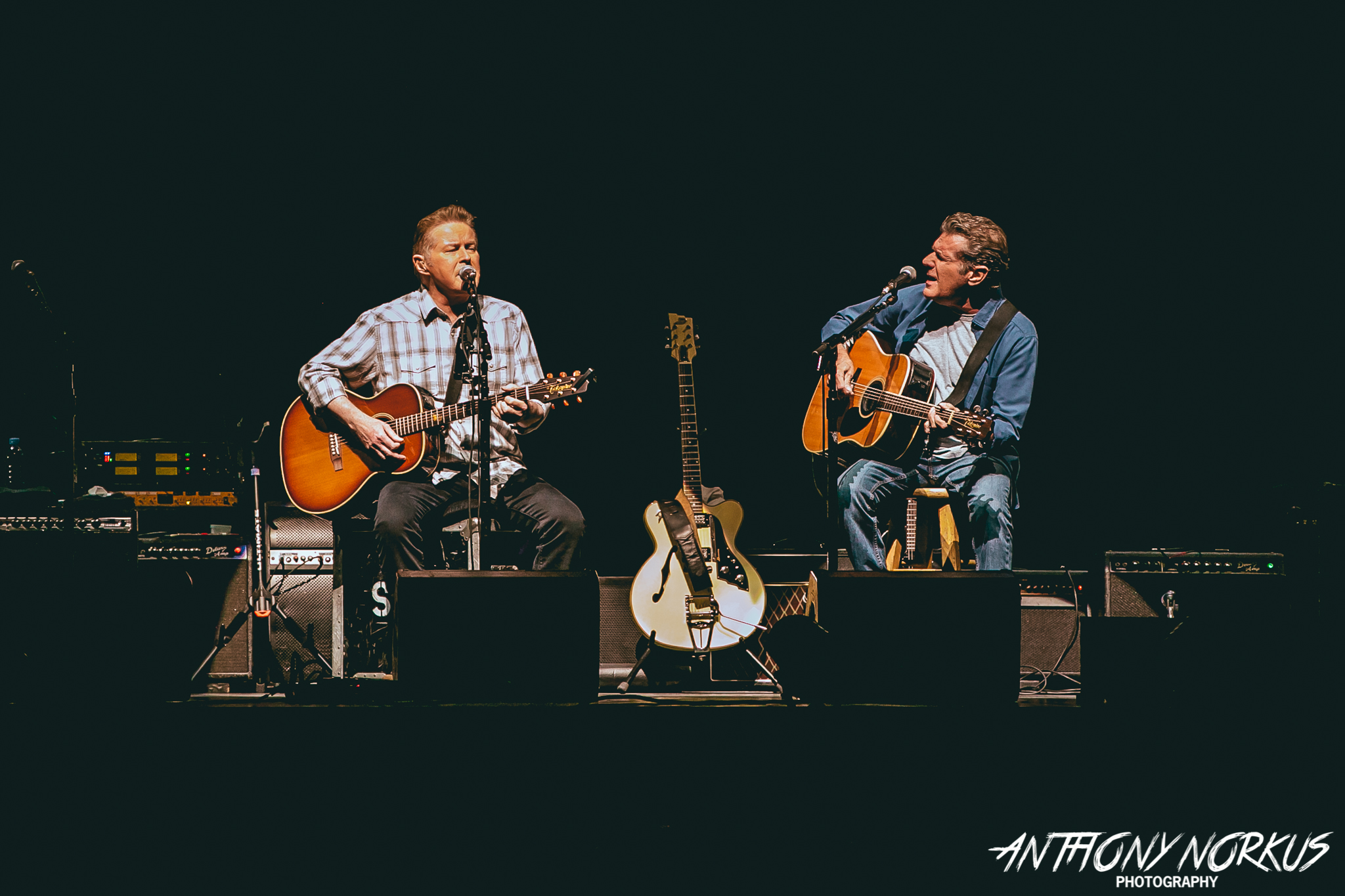
Don Henley and the late Glenn Frey at Van Andel Arena in 2014: Henley warned years before about music industry tumult. (Photo/Anthony Norkus)
Call them bellwethers, prognosticators, prophets, soothsayers.
Support our coverage of
West Michigan's music scene
Many of the legendary rock artists I’ve interviewed over the years have signaled accurate warnings about the future of the music industry – from the loss of record sales due to streaming to outright theft of songwriters’ music.
Among the most vocal pundits? Singer and drummer Don Henley of The Eagles, who fire up another much-ballyhooed residency at the Las Vegas Sphere starting Nov. 13.
When I interviewed Henley in 2002 – four years before Spotify was launched – he railed against “Napster clones,” referring to spinoffs of the pioneering file-sharing network.
“These are scary times for artists,” he told me 24 years ago. “So much is happening so quickly, it’s hard to keep up. And there really isn’t anybody looking out for our interests.”
Indeed. In the decades since, things have moved even more quickly than most could imagine when it comes to the upheaval in the music industry, with AI (artificial intelligence) the most recent attack on creatives.
Henley, then 54, labeled the music industry at that time as “ugly,” filled with record company tumult and artist control issues.
“If you can, always be in business by yourself,” he said, adding that copyright infringement was becoming a problem.
“I am concerned about it because songwriting and making records is the way I make my living and Napster and Napster clones of where there are many are a threat to my livelihood and livelihood of all of us who make records,” he said.
“Our copyrights are being stolen and exploited, and we’re not getting just compensation for it. I know there are a lot of young people who don’t agree with me, and you know, I can only say that someday they’ll understand. … If it continues, it’s going to have a real chilling effect on the industry. If our music is going to be stolen, then nobody’s going to want to make music anymore.”
Lighting Up Grand Rapids in 2018: The Eagles.(Photo/Anthony Norkus)
He also cautioned young artists that “the worst mistake is not understanding a basic record contract. Have your own lawyer and make sure your own lawyer is someone you can trust. A lot of artists don’t pay attention to the business part of their career and you HAVE to pay attention.”
Admittedly, as one of the most successful rock bands of all time, The Eagles – now in their late 70s – have fared incredibly well compared to most artists, and they continue to impress audiences, with three upcoming stints (November, December and January) at The Sphere.
Part of that stems from their attention to detail and rehearsing their harmonies before shows.
I once had the opportunity to hang out back stage briefly with the band in St. Paul, Minn., listening at the dressing room door as guitarist Joe Walsh practiced his riffs and solos before taking the stage, and chatting with bassist Timothy B. Schmit about the group’s “heavy rehearsals.”
“We … go into a lot of details about the show, even the songs we’ve done for a long time. We keep honing it down and tuning it up,” Schmit said. “We work really hard and we’re all giving it our best at these shows. Every venue’s different and every hall has different acoustics, so we check those aspects out.”
A FORMER EAGLE SPEAKS OUT
Of course, not every Eagle has soared to the same heights as Henley and company.
A couple years after chatting with Henley, I spoke with singer-guitarist Bernie Leadon, one of the founding members of The Eagles who left the band in 1975 — before the recording of the iconic “Hotel California” and just as the group reached superstar status.
“I left for very good reason – my own sanity and health. I went to the beach for the next three years and ate really good food and got really healthy and strong, and I needed to do that,” he told me, saying he didn’t regret the move despite missing out on the overwhelming success that The Eagles have since enjoyed.

Bernie Leadon, ‘Mirror’
“I was on the train until it got huge,” he said, noting his contributions to every track of the first greatest hits album. “I turned my back on millions of dollars a year, but that was my choice. … I really needed a long break.”
Leadon, who had just released his solo album, “Mirror,” at the time of the interview, later did join The Eagles again as a special guest during their “History of the Eagles” tour in 2014.
Even Leadon acknowledged the turbulent nature of the music industry during that interview two decades ago, calling the market “fragmented” with little attention to artist development.
“There’s no doubt that the entire music business we’ve known for 40 years is changing forever,” he told me.
“Illegal downloading is sucking the profit right out of it for medium and small groups. I’m afraid people don’t understand what they’re doing when they make it impossible for songwriters and musicians to make a living.”
Just another oracle in the world of rock.
More to come next week as Local Spins continues its “Rock Legends Revisited” series, resurrecting classic interviews with influential stars.
Check out other posts in the series:
Ringo Starr savors the stage; Pete Best rebounds from career blow
Classic interviews with The Who, B.B. King & more
Copyright 2026, Spins on Music LLC