In 25 years, Local Spins founder John Sinkevics has interviewed many icons from the rock ’n’ roll era. Today, Part 1 in our rewinding of some revealing conversations with these influential artists.
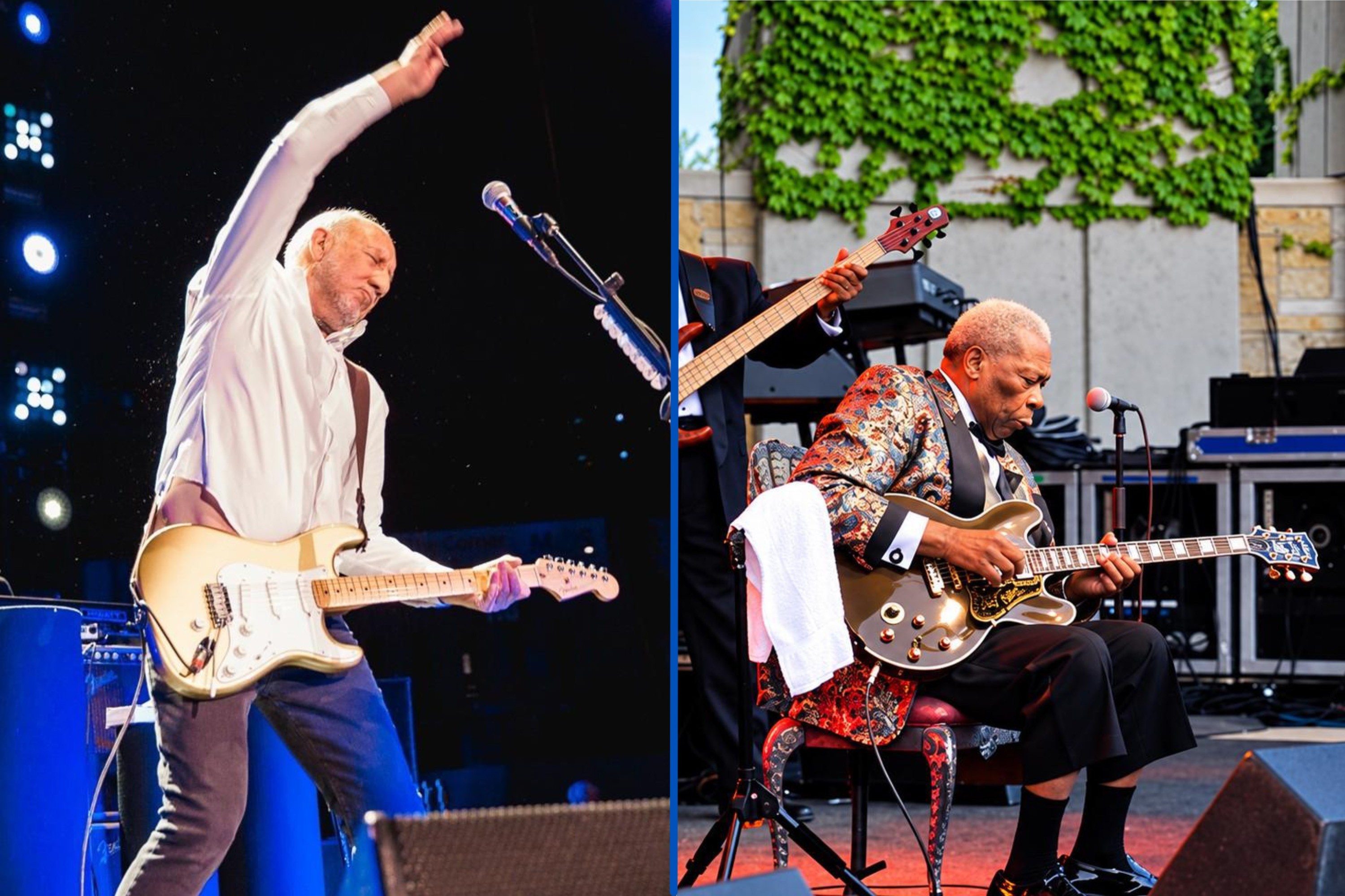
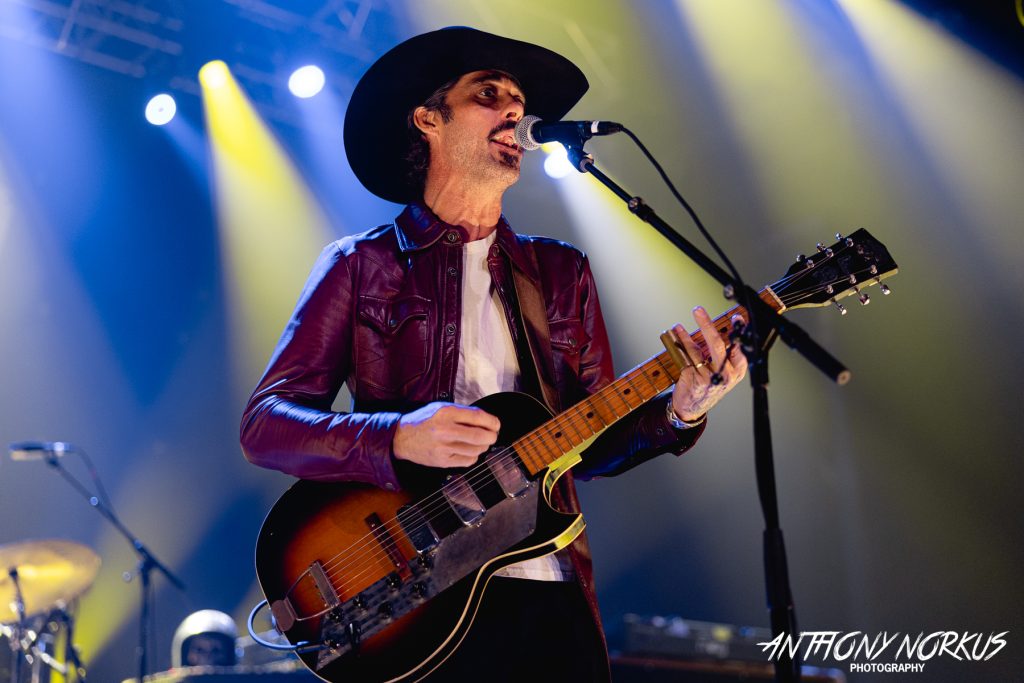
‘Performing is Intriguing’: Pete Townsend of The Who and B.B. King shared revealing insights during interviews revisited today. (Photos/Anthony Norkus/Anna Sink)
Some music historians contend that rock ’n’ roll celebrates its 75th birthday in 2026, the “birth” represented by Chess Records’ 1951 release of “Rocket 88” by Jackie Breston & His Delta Cats, aka, Ike Turner and band.
Support our coverage of
West Michigan's music scene
Of course, in truth, the roots of rock are a moving target – inspired by African-American blues, gospel and rhythm & blues, eventually exploding as a mainstream phenomenon in the 1950s and 1960s.
I’ve been lucky enough to savor and revel in much of that robust history, with The Beatles literally changing my life as a youth – my ears plastered to a little black transistor radio as I collected Beatles trading cards and 45s, and finding myself mesmerized by the Fab Four’s 1964 appearance on “The Ed Sullivan Show,” undeterred by the fuzzy reception of my cousins’ black-and-white TV.
Luckier still, over the past quarter-century as a music journalist, I’ve had the unique opportunity to interview some of the legends of rock (not to mention iconic artists from other genres), delving into their motivations, their passions, their creative processes and, yes, their mistakes.
I’ve touched on some of this in Local Spins’ “Classic Rock Corner” features – reflections on past interviews – but it’s been many years since I’ve revisited those conversations, not to mention many more in-depth chats with artists who helped changed the direction and sound of rock ‘n’ roll.
In my view, it’s more important than ever to acknowledge these influential artists who are not only reaching the end of their careers but the end of their very lives – and we’ve already lost too many beloved musicians and songwriters as it is. Despite that inevitability, many also continue to create memorable new music, including the Rolling Stones, Bob Dylan, Ian Hunter and so many others.
As Carlos Santana once told me, “If you’re bored, you’re old. I don’t allow myself to get bored.”
Not Allowing Himself to Get Bored: Santana at 78 playing Acrisure Amphitheater in June. (Photo/Chelsea Whitaker)
Or as 78-year-old B.B. King remarked when I interviewed him in 2004 before a show at Frederik Meijer Gardens & Sculpture Park:
“I do it because I enjoy doing it and I think the music is good, and if I didn’t get out and play, people would never hear it because we don’t get many records played on the radio. … I figure that sometime in my life the great God will retire me. But I feel good at 78 years old and so long as people keep going to see me as they have been, I see no reason to quit. Why should I retire? I like fishing and like watching TV, but not all the time. (Music) is the one thing I’m happy with.”
Oh, and guess what? Nine years later, at age 87, he actually played Meijer Gardens again. Not long after, as he expected, God did finally retire him at 89.
Singer-guitarist Johnny Rivers, now 83, told me that performing live was “the ultimate kick” even as rock’s musicians enter the AARP years. “That’s why guys like Springsteen and McCartney and Bob Dylan are out there playing. It satisfies something in an artist that nothing else can do. You get that exchange and feel that electricity from audiences.”
Perhaps I’ve gotten more nostalgic as the years have flown by, but I felt compelled to resurrect some of my interviews with these legends and share parts of them today – on the 68th anniversary of Buddy Holly’s final recording session and the 50th anniversary of Keith Moon’s final performance with The Who.
While on the subject of The Who, my interview 20 years ago with guitarist Pete Townshend produced some surprising perspectives.
“Performing is intriguing to me rather than exciting,” he observed. “I am always surprised by how it can be so different from show to show.”
He also noted that the band found it easier to travel in the New Millennium than in the early years: “The world is more amenable to treating rock stars like human beings these days. Some of our bad behavior as young men was a response to the way we were treated, not the challenge to authority and order as it was seen to be by the press. We travel and hotel elegantly today. Our fans treat us like precious friends, not chattel.”
(Clearly, The Who’s quintessential line, “I hope I die before I get old,” didn’t carry the same weight as it did when Townshend was 20.)
Interviewed the same year that Spotify made its debut, a kind, gracious and revealing Townshend also accurately predicted the effects of streaming on artists – noting that while The Who’s music and videos were now being widely distributed “neither do we get paid anything. … Without the touring income we are enjoying, there would be no Who CD, no Who web activity, no new songs from me, no interest whatsoever in anything but maybe selling my life story to a book publisher and getting on ‘Oprah’ to talk about the good old days. The Internet must start paying artists fairly for content, somehow.” It’s a refrain still expressed by artists today.
Townshend also added: “For a while during 2005, Roger (Daltrey) and I were thinking of giving up The Who brand and just doing charity shows, being old buddies and taking up golf.”

At Van Andel Arena in 2019: Townshend said Daltrey transforms his songs into ‘Who music.’ (Photo/Anthony Norkus)
With more than a touch of fondness and nostalgia, Townshend heaped praise on Daltrey and late bassist John Entwistle: “What (Roger) does works to transform what I write into the kind of rock music people understand as Who music. He adds edge, bravura, anger, pure masculinity to my songs that are sometimes vulnerable, full of mixed messaged and indecision – Roger seems to add certainty. … I know there are times Roger would prefer me not to be so noisy and flashy on the guitar, but he allows me to be who I am and to do what comes naturally to me.”
On Entwistle: “On stage, I miss the thunder. Off stage, I miss the dry wit, the calmness, the kindness, his gratitude to me, his irritation with me. I played music with John since I was 12 years old. I sound like a resigned widow when I say we had 45 years together. John was quite simply adorable in almost every way … the most easy to love of all the original Who members.”
Townshend’s poignant responses stand out among the interviews I’ve been fortunate enough to conduct with some of rock’s central figures, but they’re certainly not atypical of the forthright replies to questions that these musicians have sometimes surprisingly elicited.
For more proof of that, come back next week, when I revisit some of my conversations with the likes of Ray Charles, Robert Plant, Eric Burdon, Ringo Starr and, yes, Pete Best.
Copyright 2026, Spins on Music LLC