The acclaimed singer-songwriter plays twice this weekend at Listening Room, along with screenings of the documentary about him, “Strange Negotiations.” The Local Spins interview with director Brandon Vedder about this film and the difficult journey of its artist.

On the Road: David Bazan at a house show in a scene from the documentary film. (Courtesy Photo)
SCROLL DOWN FOR FILM TRAILER
Support our coverage of
West Michigan's music scene
A NOTE FROM AUTHOR RICKY OLMOS: My fascination with indie-rock singer-songwriter David Bazan’s work didn’t begin until late 2015. I didn’t know much about Pedro the Lion or David Bazan. So when the combination of a brilliant podcast interview, an article recounting Bazan’s 2009 Cornerstone Music Festival performance, and the opening instrumental passage to his 2009 album, “Curse Your Branches,” all hit me in the same week, I finally (20 years into his career) became consciously aware of Bazan and his meticulously created catalog. I was pulled in by his story and stayed because of the clarity, texture and resilience with which he told it.

Earlier this week, I spoke by phone with filmmaker and director Brandon Vedder whose film, “Strange Negotiations,” focuses on and is inspired by the 43-year-old Bazan. It premiered this year at SXSW in Austin. The film holds a mirror to evangelical Christiananity and the country’s political crisis, while following the tumultuous story of the Seattle-based Bazan, whose fallout with both Christianity — and much of his original fan base tied to his band Pedro the Lion — are well-documented.
Toward the end of our upbeat but intense conversation, Brandon grew somber when stringing together the words for what is undoubtedly both a researched and experienced account of his findings during the making of the film. “It’s scary, because in the following generations as the world gets more and more intense in every way, we need artists, we need these voices to get through this shit and to help people understand and cope. And if we’re uprooting an entire class of artists, it’s even darker than it was going to be before. If there’s no art to go along with the tragedy. Just tragedy by itself is much worse.”
The film will make its Midwest premiere this weekend, screening twice at Celebration Cinema at Studio Park, 123 Ionia Ave. SW, at 6 p.m. Friday and Saturday, just ahead of two 9 p.m. solo performances by Bazan at Grand Rapids’ new Listening Room, on the second floor at Studio Park. Concert tickets are $25 and available online at listeningroomgr.com; film tickets are $11.75 adults, $9.25 children/seniors, $10.50 college students, available here.
This Q&A and the film itself evaluate the vital signs of blue-collar artistry, which are alarming. It provides an honest and disconcerting window into the work and everyday reality of the artistic entrepreneur.
Local Spins: Thanks for taking the time to talk about this film. How’s the promotion and release cycle going?
Brandon: It’s so nice to finally be getting it out there. There’s still a lot of people who haven’t gotten to see it yet, so it’s very much in that exciting beginning. This thing has been inside my head or on hard drives for so long.
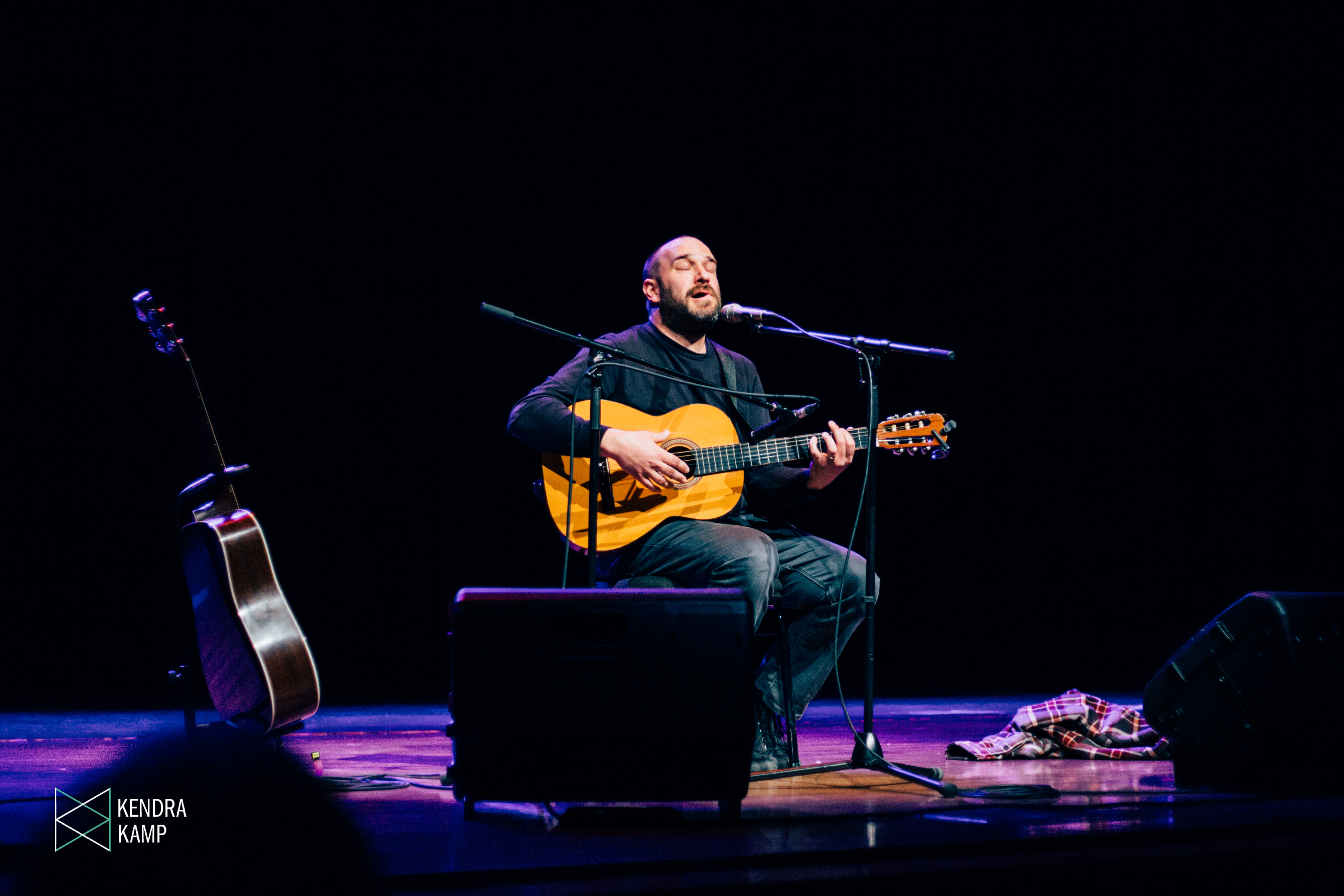
On Stage at Calvin: David Bazan performed there in 2017. (Photo/Kendra Kamp)
Local Spins: How did you get acquainted with David and his work?
Brandon: I became familiar with Pedro the Lion when I was in high school. I was blown away by the tonal element and the storytelling, which is so rare, especially in that time when it was up against pop-punk and shit. Then I kind of lost track of him, as most people did, and the film tells the story about when Pedro broke up and he went off into the proverbial wilderness to figure it out.
Local Spins: What first compelled you to tell his story?
Brandon: About a decade ago, I was finishing up my previous film and had to go down to San Diego for this shoot. I downloaded a bunch of podcasts and one of them happened to be “You Made it Weird with Pete Holmes,” where he interviewed Dave and I downloaded it because I thought, ‘Oh yeah…shit, I haven’t thought about David Bazan in forever’ and I was just floored by this interview. That was the first time I heard the whole story about his loss of faith and the way he interacted with music through that loss of faith. Just the candor and the way that he communicated these ideas and feelings that so many people had was really special to me.
When I got home from that trip I couldn’t get it off my mind. I ended up downloading and printing off every single lyric he ever released and bound together this little book. I wanted to sit and look at it as a narrative and immerse myself in this story from song to song. I saw this piece of literature and scholarship, this blistering front-row access to a person losing their entire worldview where there’s so much storytelling and exploration on both sides of the fence but so little that stays in the nuanced middle … and it just blew me away. It was non-prescriptive, it wasn’t damning one way or another, just a person telling their truth who could communicate better than any of us.
You only get so many chances to put something into the world and to make something. So I’ve always tried to keep a fidelity between what I’m going through in my life and what I’m curious about exploring and uncovering, what I think is helpful and the subjects I’m choosing. When you treat a project as your job, it’s much easier to sit down and research. I’ve probably read 20 books on evangelical Christianity and its impact on American culture, and its impact on politics. It gave me a reason to do all this research and to understand where we’re at so much better. A lot of that didn’t make it into the film, but I think that’s in its DNA.
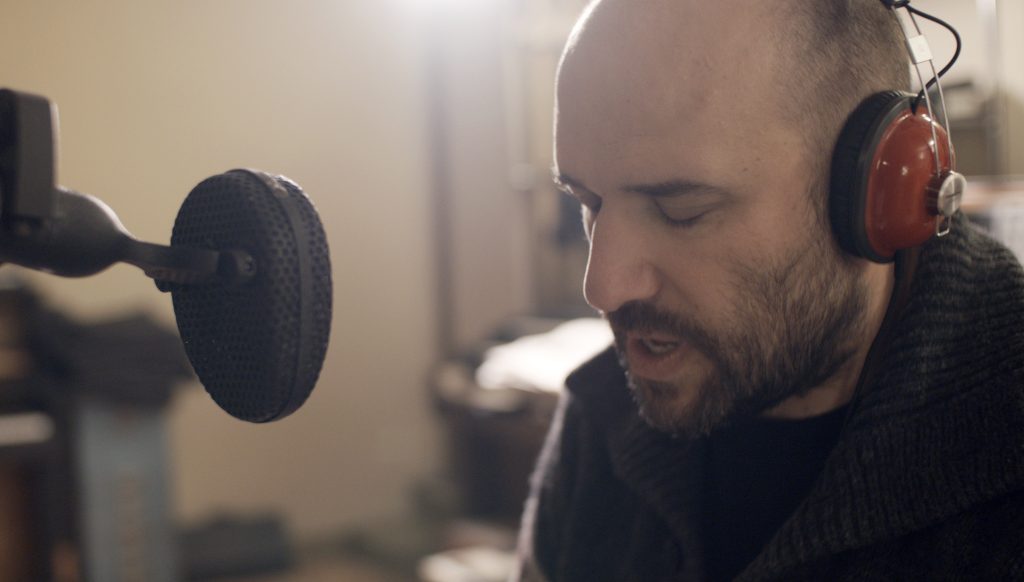
In the Studio: Another scene from the documentary. (Courtesy Photo)
Local Spins: Can you walk through the production timeline?
Brandon: There’s such an interesting journey with this film specifically because I’ve kind of known from the beginning that I wanted to reserve judgment on what it was and what I wanted it to be. I knew there was enough here that compelled me to tell the story. I think that’s kind of the ethos of Dave’s journey as well: Let’s take this ride, let’s take in data. Instead of trying to prove something, let’s continue to take in data and apply it to reality.
Local Spins: Were there any specific moments or decisions that became a catalyst for the film’s success?
Brandon: The Kickstarter was a massive part. There was an incredible amount of support and love from this community that Dave has built. He has such a different relationship with his audience because most of the people who are diehard fans have been through a similar thing that he went through in telling his story. There’s so much emotional attachment and cognitive attachment on all these different levels. He was the voice in your ear when you were in the foxhole. It was amazing to see that whole crowd show up. There’s so many artists and writers and incredibly talented and creative people who became collaborators on the film because of the Kickstarter. Announcing it created this incredible groundswell and it gave me the latitude to stretch out and not make judgments before I had to.
Local Spins: Which can also put you in a box creatively.
Brandon: Totally. And then you’re trying to prove an idea. You’re putting stilts under that idea, trying to prop it up instead of shaving the weeds around something to figure out what the actual healthy, helpful version is. I also got a grant early on in the process from this company called Fork Films run by a filmmaker and activist named Abigail Disney, who’s based in New York.
Local Spins: What are some other non-traditional techniques you utilized to set the tone or tell the story?
Brandon: I had my recipe book of how I was going to capture stuff. I knew from the very beginning that I wasn’t going to do any regular sit-down interviews. It was never going to have this normal documentary interview feeling. I didn’t want to break the fourth wall in that way. I wanted to let the audience be a fly on the wall in these scenes without breaking the rhythm of Dave’s life. I knew these long drives he would take every day from show to show would create this perfect opportunity for that. Technically, it was a nightmare: you know, with a moving car, light changing every 10 minutes, sound was difficult. But I knew I would have five or six hours a day in the car with this guy where I could open up the front of his head in a way that didn’t seem like he was answering interview questions. It was just his thoughts, his way of processing things.

Night Drive: The long journey of David Bazan. (Courtesy Photo)
Local Spins: What was it like to travel and document Dave’s life so closely?
Brandon: There’s this fever-dream element about what he does. He wakes up in a different hotel every day, the living rooms start looking the same, people start looking the same. It’s easy to lose yourself in this thing.
Local Spins: Were there any moments early on that propelled the film’s production?
Brandon: It was late summer of 2015 that I went up to Seattle as a kind of test. It was pretty clear this was going to be a creative challenge, making something that threads this line between music, and faith, and deconstruction, and the loss of the middle-class artist. He did a string of house shows in the Pacific Northwest that gave me this understanding of the conversations that were possible at these shows. I felt uniquely qualified to make the film before that, but that was definitely the moment where it was like ‘OK, hell or high water this is happening.’
Local Spins: How did making the film affect you personally?
Brandon: There’s this balance of trying to be an artist, and a dad and a husband. And this this ever-changing balance was mirrored in Dave. A lot of the emotional aspects you see in the film are directly related to being gone so much and feeling like the balance has been messed up. That’s something I deal with as a filmmaker who travels. It’s in my head a lot. There’s this exploration of self through Dave. That’s why I hope it can transcend being looked at as just a music documentary. I’ve been working really hard to keep the framing as broad as possible.
Local Spins: Were there any observations you found troubling while making the film?
Brandon: I think we’re in a moment right now in American history where art has been devalued in this way where everyone feels like they should have access to this stuff for free, which directly impacts the actual performers obviously. It used to be that you needed to travel to promote records and records would be the thing that actually made the money and the mortgage, but especially for Dave, and a lot of other musicians right now it’s totally the opposite. The only way they can make money is by touring and having that minimum guarantee because records don’t do shit anymore.
You want to have balance, but the only way that you get paid is this thing that upsets the balance. The bummer is watching a musician as talented as Dave, who can handle a room as well as Dave, having to struggle so hard just to make ends meet. Like not even pay for an extra car in the family just to keep a roof over his kids’ heads and keep the water on. It’s people doing some of the most important work in the world. We literally go through the darkest time of his life through the film.
Local Spins: Can you tell me about the sound and the music in the film?
Brandon: That was an incredible process. We worked with Skywalker Sound out of Northern California. We were able to get stems for almost everything he’s ever recorded and do 5.1 theatrical mixes, moving these instruments around the room. The sound of this film, in general, almost drives the story more than the picture — in every scene.
Get more info about David Bazan’s performances at Listening Room online here.
VIDEO: “Strange Negotions” (Official Trailer)
Copyright 2019, Spins on Music LLC