The second installment in our series on the power and dangers of AI on the music industry focuses on the views of veteran Grand Rapids sound recordist Joseph McCargar and worries about theft.
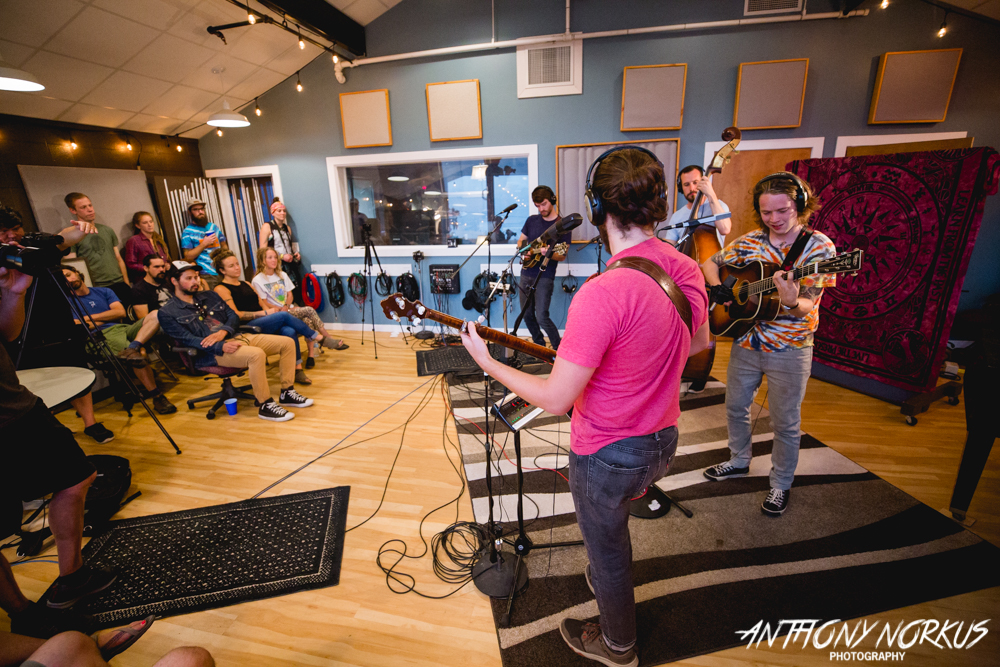
A ‘Real Music’ Environment: Billy Strings and band at River City Studios in 2018. Interaction that AI can’t replace. (Photo/Anthony Norkus)
EDITOR’S NOTE: Today, Local Spins presents Part II of a continuing series on the effects of artificial intelligence (AI) on music, songwriting and recording. The fast-emerging technology already has had a big impact on the music industry, though opinions vary on just how it will alter the creative process and affect musicians. Local Spins asked several well-known Michigan studio owners and engineers for their takes on AI. Today, we spotlight veteran engineer Joseph McCargar, senior sound recordist for Grand Rapids’ River City Studios.
Support our coverage of
West Michigan's music scene
Local Spins’ first story on the AI revolution in music drew a flurry of intriguing comments from musicians.
Wrote Justin Wierenga: “If AI could ever haul my gear to the gig, or tune any of the 40 or so changes my pedal steel guitar makes, I’m in. Oh wait, it just makes s–t music and drains valuable resources.”
“AI can’t write a Joni Mitchell song,” quipped Mark DeWitt.
Asked Adam Main: “Is it possible to ruin the recorded music industry more than it already is?”
“People were against AutoTune and now it’s industry standard. Not saying AI will be that way, but it sure seems to be heading that way,” noted Todd Long.
Added Stephen Aldrich: “To dismiss it outright is much like those who argued that synths and drum machines would replace musicians. … Those who learn to harness the technology, and use it to a positive degree, will benefit.”
Other comments related to copyright concerns — not only the propensity of AI music platforms to retain the copyright of music created within their services, but widespread worries about businesses that use AI to appropriate songs, or parts of songs, created by musicians and songwriters for their own projects.
In fact, an organization called “Stealing Isn’t Innovation” has signed up hundreds of artists — including the likes of R.E.M., Cyndi Lauper, MGMT, The Roots, They Might Be Giants and The Hold Steady — who object that “some of the biggest tech companies, many backed by private equity and other funders, are using American creators’ work to build AI platforms without authorization or regard for copyright law.”
The organization states: “Stealing our work is not innovation. It’s not progress. It’s theft – plain and simple. A better way exists — through licensing deals and partnerships, some AI companies have taken the responsible, ethical route to obtaining the content and materials they wish to use. … We can have advanced, rapidly developing AI and ensure creators’ rights are respected.”
The idea that AI can be a valuable tool for some tasks, provided it’s used properly, was shared by several Michigan recording engineers, including Joseph McCargar, senior sound recordist for Grand Rapids’ River City Studios and affiliate professor of film and video production at Grand Valley State University. But he also suggests that AI-generated songs be labeled as such. Here’s his take on the subject.
Q: What’s your current assessment of AI and the biggest impact — or most obvious change — that this technology already has had on the music business?
A: “I have not noticed an obvious change yet in our business, though more people are talking about it, specifically about Suno™. I believe the app fits the needs of individual singer-songwriters who want to see how their music might sound if . . .”
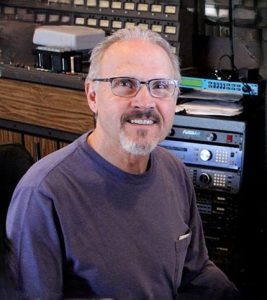
Joe McCargar (Courtesy Photo/GVSU)
Q: Has the advent of AI altered what you do as a studio engineer/producer?
A: “What AI I have heard sounds excellent. However, there are individual instrument and voice qualities that I have heard before, and mostly have achieved in the real music environment. None of it has changed my approach to tracking or mixing, since there are well-established essential ideas about balance, EQ distribution, panning, etc. But I’m learning new and creative variations on the established processes all the time. The developers of AI seem to have caught on to these requirements of satisfying and active listening. AI’s use simply makes it quicker to get there, an advantage.
Q: Are you worried about the future of studio recording and your business because of AI’s rapid emergence?
A: “I have been concerned about every new development in recording technology since I entered the business in 1977. By taking an earnest interest in those developments, we humans have – I believe – successfully adapted to the inventions that concerned us at the outset. The thing we used to call a drum machine once scared the crap out of live drummers. But by simply making it a normal part of their repertoire and the performance environment, they have learned to make the things do more of what they wanted. In most cases, that technology, along with MIDI and other digital control devices, have been successfully integrated into the recording environment without much disadvantage.”
Q: Should consumers and listeners be concerned and wary of music that they hear and embrace amid this new environment?
A: “This question introduces the moral, ethical and legal component of AI. Should we be wary of fakes, computer-generated or otherwise? I’m personally worried about such things as fake money or bogus transactions, fake passports, fake driver’s licenses, etc., because they all are methods of cutting corners and – in a sense – reducing the value, reliability and truth of the things they substitute for. Fakes, such as MP3 files and cheap computer speakers have come to be accepted as good sounding playback. Listeners have simply let it ride and and made it normal, while missing the joy of full-bandwidth audio. AI-generated content of most kinds, especially in the processes we call art, is a way of skirting the truth in pursuit of convenience. But like the drum machine, current AI versions of things aren’t the truth unless there’s an intimate human interface. The careful use of AI in medicine and other biological sciences may actually augment the truth, where speed and accuracy are actually a positive outcome, but not without the physician as the intimate human interface.
Q: How should musicians, songwriters and creators approach this new reality — and best compete in an already saturated market?
A: Just like other historic innovations, we should (must) all understand the scientific foundations and use of the tools. I do this best working in a real studio environment with other staff members to inform me and for me to bounce things off. Working with it as a tool, I expect to get better at using it than as many people as possible and I will use it only as a tool, not a replacement. Even at that, I’ll only use it when I genuinely feel that I’m adding value for our clients.
Q: Using AI is remarkably intoxicating for a musician. To test it, I recently used the Suno / AI Music site — feeding it lyrics and a basic melody played on piano while choosing various musical styles/genres. Within minutes it had spit out fully produced songs. Have you tested any of these AI formats, and if so, what’s your impression?
A: My impression is essentially, ‘Wow.’ Maybe more like ‘Whoa.’ I, too, found myself a little intoxicated after hearing the examples. After the developers make use of every digitally sampled human voice (spoken or sung), bass drum, snare drum, guitar, violin, bass, etc., in the known cultural universe, they can make something very nice. There’s always been a wide market for counterfeit creativity. In turn, people will make this content into money. Ask all of the workers in the movie business as they rebelled against the industry, quite successfully. But just as I won’t pay good money for cheap things, my plan is to segment my saturated market of things and do my best to read the label and know what I’m paying for. As a recording engineer, I will encourage our potential clients and audio listeners to do the same. Every form of A.I.-generated art should have a label, just like cigarettes, food, alcohol and every other dangerous or potentially abusable content in the marketplace. Then, whether to consume it or not becomes an opinion, judgement or preference. I’m counting on the audio consumer and creator to opt for art that they build from the ground up. Then they can feel the real joy of creativity and learn a great deal about the recording process AND themselves. Given current creative culture, there is no guarantee that they will, and it will take a concentrated effort adapt.
Stay tuned for Part 3 of ‘The AI Revolution in Music’ next week. Check out Part 1 here. For more information, The New York Times recently published ‘Where is AI Taking Us?’
Copyright 2026, Spins on Music LLC