The power and dangers of AI in music are real and expanding at lightning speed. In this series, Local Spins will explore the sometimes-scary technology with respected Michigan recording engineers.
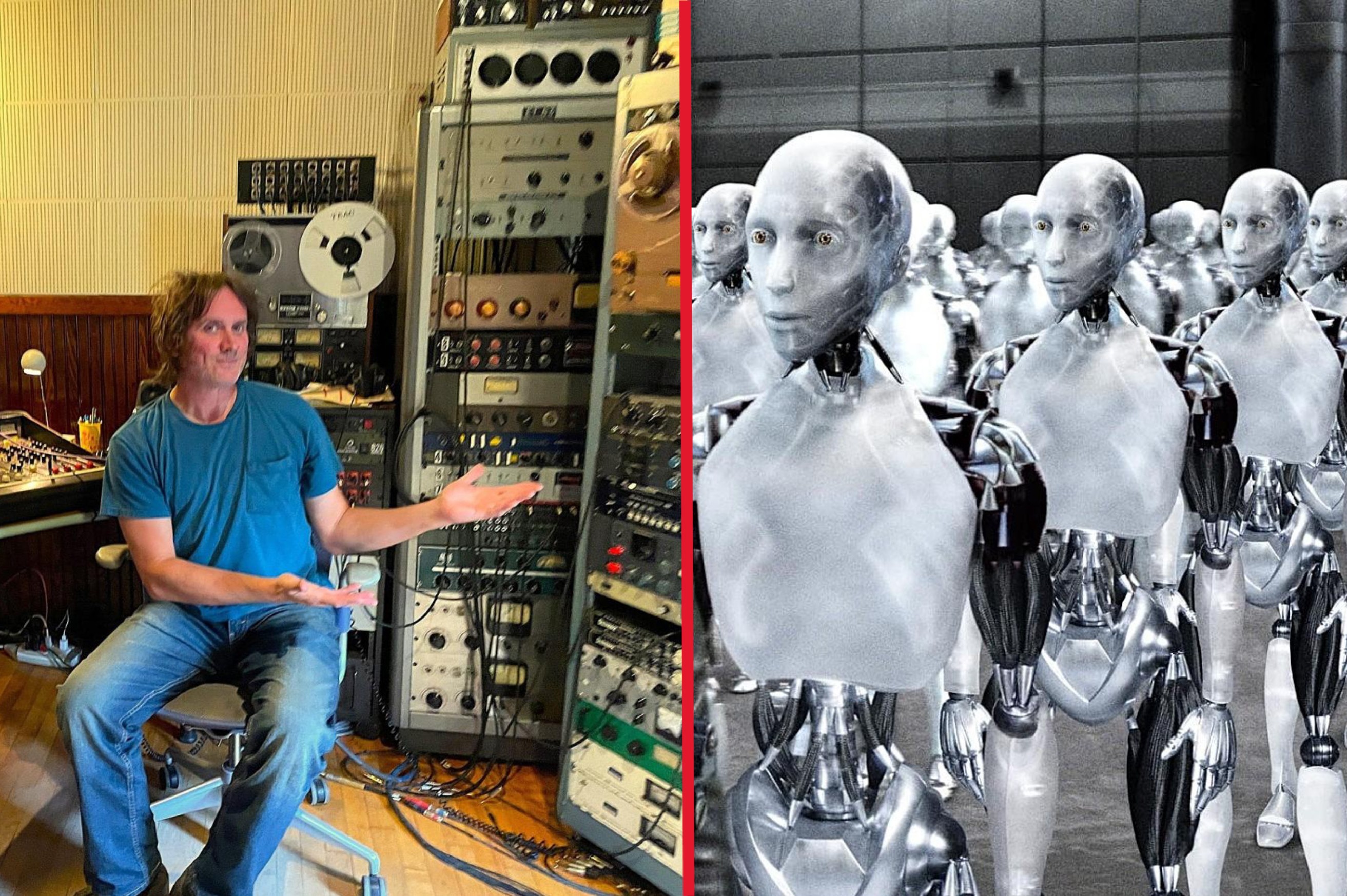
The Real Thing Vs. The Artificial: Tommy Schichtel at Goon Lagoon and an image from “I, Robot.”
To say that AI – artificial intelligence – is revolutionizing the music industry could be a colossal understatement. Or is it?
Support our coverage of
West Michigan's music scene
The power, the dangers and the unmistakable benefits of this fast-emerging and universe-changing tool already have invaded pretty much everyone’s everyday activities, online surfing and work routines.
It’s providing us with detailed information and technical knowledge at breathtaking speed – and sometimes in error-filled fashion.
It’s given folks with limited skill or knowledge on a subject with near-instantaneous expertise – and likely putting millions of people out of work.
In music, its ability to create “new” songs embraced by listeners worldwide is astonishing: Roughly 50,000 new AI-generated tracks are uploaded to Spotify EVERY DAY. Some of them even have risen up Billboard charts, including a No. 1 country digital song sales track (“Walk My Walk” by Breaking Rust), along with other songs created by so-called “AI artists,” you know, not real performers or real humans. (Scroll down to listen to “Walk My Walk.”)
Granted, I got that information via, yes, an AI Google search, but it all raises some troubling concerns: Can the average listener – or even a discerning producer or musician – tell the difference between an AI track and a song created by actual musicians and writers?
To test AI’s skill in creating fully produced songs, I tapped into one of the most popular and highly rated AI music-producing sites, Suno. This AI music platform offers a stunning variety of options for users at relatively low cost — users who can tap out a simple melody and a few words, tell Suno what style of music they prefer, and end up with a new song. (It’s just $8 a month for a “pro” plan, with a “premier” plan at $24 per month.)

Suno: Praised and reviled?
In my case, I sang and played an original song on my keyboard and recorded it in rudimentary fashion via the voice memo app on my iPhone and uploaded it to Suno. I added my lyrics, suggested a few styles (rock, Southern gothic) and hit “Create.” In little more than 5 minutes, Suno returned with two separate, fully produced versions of my song that initially dazzled me.
It was as if superstar Chris Stapleton was singing my creation backed by Nashville studio session players.
Granted, it wasn’t exactly how I wanted my finished song to sound – or how I would prefer my band to play it in more raw and edgy fashion – but those I shared it with agreed that this polished and professional track came off like a radio-ready product. One friend even thought it came from the soundtrack of a movie, before I revealed its true origin.
But as I attempted to tweak this AI creation, suggesting different styles or instrumentation, it seemed to fall even farther from my intended target: Essentially, the song got more convoluted and less appealing … and more generic.
Now, let me be clear: I have little skill when it comes to sound-mixing or audio technology, so in the hands of a more proficient user, I have little doubt that this track could shine beyond my initial foray into Suno’s potential.
But is it real? Does it reflect the magical interaction between musicians and the inimitable product of their creative chemistry? Clearly, it does not.
And while I uploaded an original song that I created into this non-human interface, what about those who merely suggest a rudimentary melody, lyrical theme and “make this sound like Taylor Swift?”
THE REACTION FROM RECORDING STUDIO VETERANS
To more thoroughly investigate the pros and cons of this formidable AI technology, I surveyed several well-respected Michigan audio engineers and producers to get their take on this life-changing trend – with some eye-opening results and commentary that Local Spins will explore in a series of essays on “AI in Music.”
Let’s start today with an iconic old-school studio guru whose Goon Lagoon in Grand Rapids still revels in all-analog recording and vintage instrumentation. Tommy Schichtel’s in-demand operation leans on a classic MCI/Sony reel-to-reel recorder that transfers music unfurled amid the studio’s unique vibe onto two-inch tapes.
Not surprisingly, then, Schichtel has no use for AI – and little good to say about it – when it comes to the music business and recording.

AI Can’t Replicate the ‘Emotion and Energy’ in the Studio: Tommy Schichtel. (Photo/Local Spins)
“If you’re that lazy to use AI to create any art of any kind I don’t want anything to do with you. Not you personally, but anyone that feels they need it to do their art,” he declared.
“Not just music either. I’m sure AI can be helpful in other ways in our society, but I’m not OK with art. As you know, I believe in the process. Creating music by having a melody pop in your head, assembling a band or session players to expand an idea based on their own ideas often making it even better than one ever imagined.”
Schichtel doesn’t use plugins and doesn’t even have computers in his Goon Lagoon studio.
“I know I beat to a different drum at the Goon,” he added, “but I’d rather go down in flames staying true to real art than listen to fake bands emulating faux scenarios where one robot has its artificial heart broken by finding out their beau was being cheated on by a Waymo.”
Does AI offer any pluses for musicians? Can the general public discern the difference between AI bands and true studio artistry? Is the traditional recording industry – even songwriting as we know it – headed for extinction?
We’ll dig into that and more in our series. Stay tuned for the next episode in this in-depth report.
LISTEN: Breaking Rust, “Walk My Walk”
From Wikipedia: Breaking Rust was developed using generative artificial intelligence tools to produce vocals, instrumentation and lyrics, with no human performers involved.
Copyright 2026, Spins on Music LLC