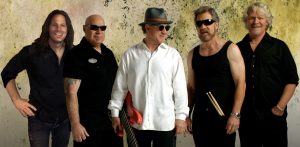
Stu Cook, center, and his Creedence Clearwater Revisited bandmates: From left, Kurt Griffey, John Tristao, Cook, Doug “Cosmo” Clifford, Steve Gunner.
Creedence Clearwater Revisited
7 p.m. Wednesday
$51 ($49 for Meijer Gardens members)
Frederik Meijer Gardens & Sculpture Park, Grand Rapids Township
Get ticket information here.
In the late ’60s and early ‘70s, Creedence Clearwater Revival ranked among a handful of rock bands which ruled the roost on U.S. radio.
Support our coverage of
West Michigan's music scene
On the strength of a unique, rootsy, swamp-rock sound born amid San Francisco’s diverse music scene, John Fogerty, Stu Cook, Doug “Cosmo” Clifford and Tom Fogerty unleashed Top 40 hit after monster Top 40 hit: “Suzie Q. (Part One),” “Proud Mary,” “Bad Moon Rising,” “Down on the Corner,” “Up Around the Bend,” “Lookin’ Out My Back Door,” “Have You Ever Seen the Rain.”
I clearly recall a radio station at the time polling fans as to their pick of the best rock band of the day: CCR, Three Dog Night or The Beatles.
These were heady years of unexpected success for a bunch of guys who met in junior high school and first formed a group dubbed The Blue Velvets.
Cook, the band’s bassist, recalls the thrill of hearing CCR’s first single, “Suzie Q,” regularly on the Bay Area’s powerhouse radio stations in 1968. “It was a dream come true,” he says.
But eventually, acrimony and disagreements with singer-guitarist John Fogerty led to CCR’s disbanding in 1972.
Clifford, CCR’s drummer, and Cook continued to work together, performing in the Don Harrison Band and operating a recording service. And in 1995, they decided to form Creedence Clearwater Revisited to perform all those beloved CCR hits for nostalgic and devoted fans.
Seventeen years later, that project – featuring Cook, Clifford, Kurt Griffey (lead guitar), Steve Gunner (keyboards, guitar) and John Tristao (lead vocals) – continues to thrive, particularly during the heavy summer touring season. Indeed, it’s lasted a lot longer than the original CCR.
“We’re having more fun, for sure,” Cook insists. “We’re senior citizens now and we have enough behind us where we can get a better perspective of what’s important and what’s not, and what’s worth worrying about and what isn’t.”
That includes not worrying about any reunion with Fogerty, as Cook discussed from a Texas tour stop in a recent, candid interview with Spins on Music:
Q: You and Cosmo have been doing this as Creedence Clearwater Revisited since 1995. Did you ever think this projecdt would last this long and become this popular?
A: Goodness, no way. We put it together half-wondering what we were doing anyhow and it’s certainly taken on a life of its own. We’re going strong. This year’s starting out great.
Q: What’s the most satisfying thing about playing CCR’s music in 2012?
A: Honestly, it boils down to the simple notion that we can actually see people having a good time while we’re playing this music and it inspires us. It’s amazing to see people, three generations of fans, grooving to CCR. It’s stood the test of time. It’s music that all generations can enjoy. It’s fairly simple and its message is fairly simple. You can feel it. These were good songs. And the idea of a new audience is good for us and we see it all over the world.
Q: Is there a difference between the CCR audiences here and overseas?
A: Each continent has its own general reaction, but they’re all fairly enthusiastic audiences. The most enthusiastic are the South Americans, Mexico and all the Latin countries are huge Creedence fans and we tour South America every 18 months. The ones that really party are the South American audiences.
Q: What’s your touring schedule like each year?
A: We keep it around 70 dates. It starts out mildly, but by the time the summer come along, we’re on a tour bus going two to three weeks at a time.
Q: So what sort of set can the audience attending your show in Grand Rapids expect?
A: We’ll play all Creedence all night. We’ll barely scratch the surface I think (in covering CCR’s extensive catalog of songs). We’ll get in as many songs as we can.
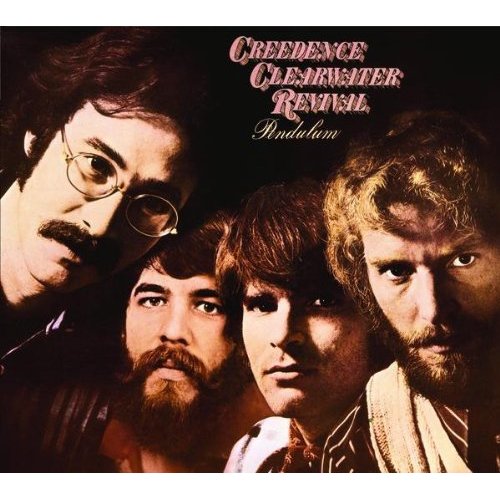
During its heyday with John Fogerty, CCR released “Pendulum” in 1970.
Q: What’s the biggest difference between touring in the ‘60s and ‘70s and playing concerts now?
A: Everything has changed, actually. When we first started touring, we just did weekends. Then it got a little more organized and we were able to route dates one after another. Now, that part is fairly organized.
Airports, of course, are a nightmare. The airline industry is barely functioning for our needs. So, we try to stay out of the airports by using the tour bus as much as we can. Hotels are more aware of the needs of touring musicians now. You can find hotels with 24-hour room service. That didn’t exist except in a few hotels.
Life is just better. … We’re able to have more fun in what we do.
Q: Let’s flash back to the genesis of the whole rock band thing for you and the guys who eventually became CCR. Do you remember your first gig?
A: We met in junior high. That’s when we first started to play. It might have been a sock hop at the high school. So, it was an overnight success that took almost 10 years.
Q: When you guys finally found success, that must have been a heady experience.
A: It was extremely exciting to be able to regularly hear yourself on the radio stations. There were two big powerhouse stations (in San Francisco) and we were being played once an hour on both stations.
We were one of the only groups from the San Francisco scene that was getting regular Top 40 radio play, by doing our own thing. We chose a different path than most of the other artists in our region and we were the only ones to break into that.
It was the kind of music we listened to when we were kids. We love the blues and R&B and we also had some country input. The Bay Area has incredible musical diversity. We’re influenced by a lot of artists, but nobody has really tried to or been able to do quite the same thing (as CCR), which is not surprising. We just came from a unique set of influences ourselves and that still sets us apart. It’s Americana to the core, but it’s an interesting mix of all the different socio-cultural groups of the country.
Q: Did you grow up in a musical family? I know you played piano, too.
A: Both my parents were serious players. My mom was a keyboardist and played organ, classically trained, and my dad was a trumpet player, playing Big Band and swing music. Musical instruments were always around the house. My first instrument was trumpet, then piano, guitar and bass.
Q: I recently read an interview with John Fogerty in Rolling Stone where he hinted that he’d be open to a CCR reunion with you guys. Do you see that ever happening?
A: Well, look, as long as people are alive, you can’t rule it out. But in regard to John’s public comments, he never mentioned anything to us about it. It seems to be a conversation between John and the media. I doubt the sincerity of that statement. Given that, there’s nothing to comment on.
This (Creedence Clearwater Revisited) is a great band. We celebrate and honor the music of the original band every night. We have a great time and we try to leave everybody with a good feeling. That’s our goal.
Email: jsinkevics@gmail.com