The acclaimed, 10-piece, a cappella vocal group brings its holiday show later this month to Midland Center for the Arts and DeVos Performance Hall. Writer Bill Forman interviews baritone Seggie Isho.
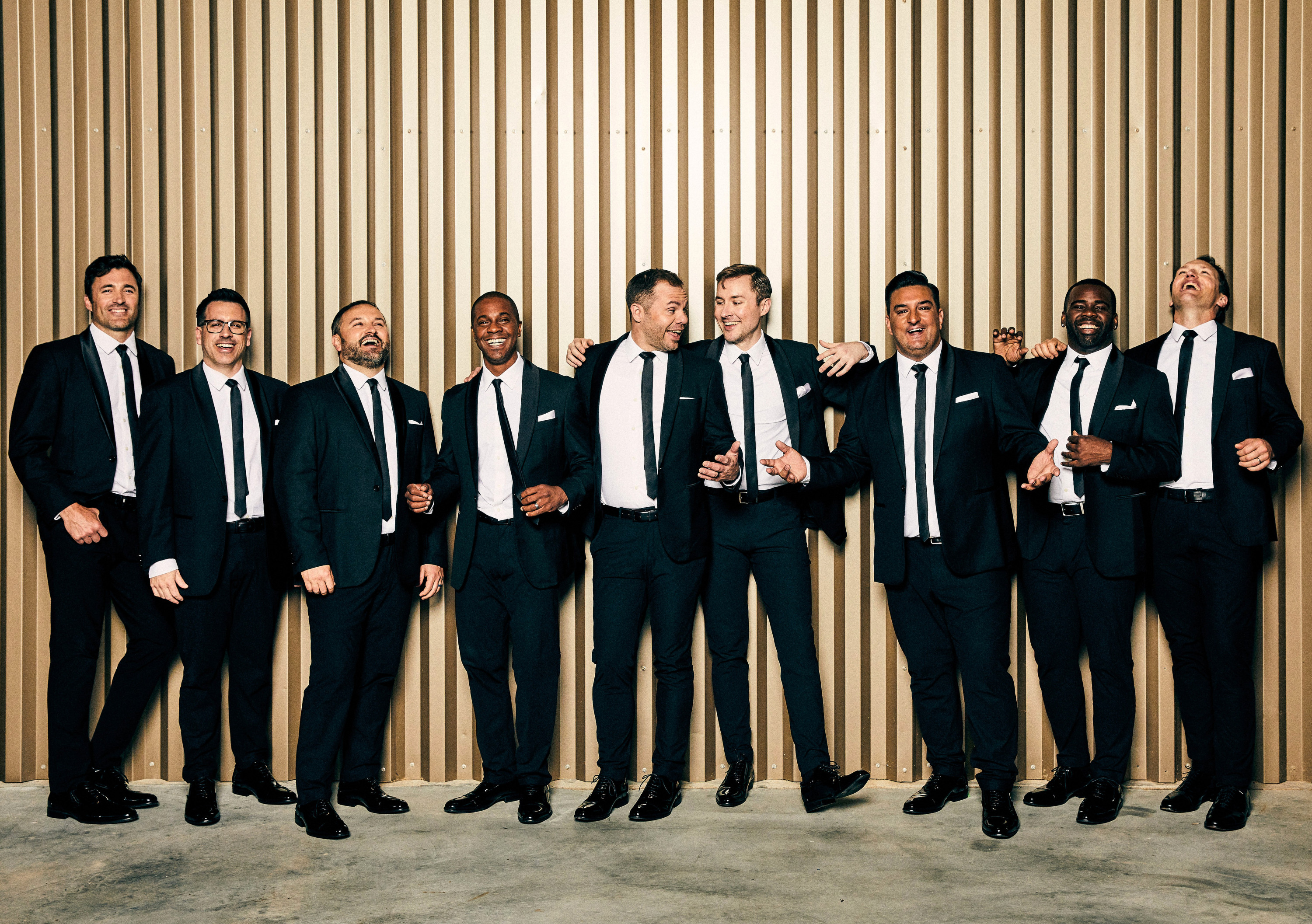
Straight No Chaser: On the holiday road again with two Michigan shows. (Photo/Jimmy Fontaine)
Most bands split up over creative differences, money disputes or standard rock-star egos.
Support our coverage of
West Michigan's music scene
Straight No Chaser has spent nearly two decades trying to survive the sheer, unadulterated perils of multi-part vocal harmonies.
The original 10 singers got together in 1996 while students at Indiana University and started out by performing at sororities (a great way to meet girls, the guys have noted) and various university events, before going on to sing at events around the country during what was a three-year run with the original members.
When the original members graduated, they moved on to various career pursuits, never expecting that Straight No Chaser would be a part of their lives again.
The unlikely return of the a cappella group stemmed from a 10th anniversary reunion of the original collegiate group in 2006. To generate enthusiasm for the occasion, bass singer Randy Stine made DVDs of a 1998 Straight No Chaser concert and posted a performance of “The 12 Days of Christmas” to YouTube.
The clip of “The 12 Days of Christmas” went viral and became 2007’s most viewed video. It caught the attention of Craig Kallman, the chairman and CEO of Atlantic Records, who tracked down Stine and offered the group record deal.
The 2026 Holiday Tour
In the years since, they’ve sold more than 3 million albums and over 1.5 million concert tickets worldwide. Their recording history has also featured high-profile studio collaborations with iconic artists like Paul McCartney, Elton John, Dolly Parton, and Stevie Wonder.
The group mounted yet another holiday tour — “Making Spirits Bright” — in October, with upcoming stops on Friday (Nov. 27) at Midland Center for the Arts in Midland (tickets here) and Saturday (Nov. 28) at DeVos Performance Hall in Grand Rapids (tickets here).
While the group has made Christmas music a priority, their catalog also includes multiple non-holiday releases, the most recent of which is 2004’s “90s Proof,” a seven-song EP dedicated entirely to pop and R&B covers from that decade. The record features a cappella interpretations of tracks like the Backstreet Boys’ “Everybody (Backstreet’s Back)” and George Michael’s “Freedom ’90.”
Incurable road warriors, the group’s 2026 touring cycle began with their “Summer Beach Bash,” a summer run where the group will perform pop and rock covers tailored for venues ranging from outdoor amphitheaters to boardwalk music piers. Now the itinerary resumes in late October with theater dates across the Midwest and South, as the group transitions entirely to its annual Christmas holiday repertoire.
In a recent interview, Straight No Chaser baritone Seggie Isho talks about singing unamplified at Tokyo’s Shibuya Crossing, managing back-stage egos on the road, and the grueling physical realities that come with the touring grind.
Q: With 10 guys singing completely unamplified, there’s no backing track or rhythm section to cover a mistake. What happens when someone misses a cue or drops a pitch?
Isho: There is absolutely nowhere to hide. If someone is flat, the entire chord collapses instantly, and all 10 of us know it immediately. You can’t just blend into the background or turn down your volume knob. It forces a level of hyper-focus where you are constantly micro-adjusting your pitch based on the guys standing directly next to you. It’s a high-wire act every single night.
Q: You’ve taken that high-wire format to international markets, including Japan, the Philippines, and Indonesia. What stands out from those dates?
Isho: The culture shock of how we were received was incredible, but the moment that sticks with me was when we went out into Shibuya Crossing. We just stood there in the middle of this massive, chaotic outdoor intersection and started singing completely unamplified. We had no microphones, no stage, nothing. Within minutes, the noise of the city just sort of faded out because hundreds of people stopped what they were doing and formed this massive circle right around us just to listen to 10 guys singing a cappella. To see a crowd gather like that purely based on the sound of human voices, in a place where we didn’t even speak the native language, was surreal.
Q: People see the viral videos or the two-hour theater shows, but what is the actual logistical reality of maintaining that vocal precision on a massive tour?
Isho: The reality is a relentless, machine-like grind. Your voice is your actual muscle, so touring isn’t just about showing up to sing; it’s about sleep deprivation, air conditioning drying out your throat on the bus, and vocal preservation. You spend your days off completely silent just to survive a four-show weekend. It’s a blue-collar touring operation disguised as a slick stage show.
Q: Ten guys living on a tour bus for decades sounds like an intense psychological experiment. How does the group manage egos and make decisions without a traditional frontman or boss calling the shots?
Isho: It genuinely is a democracy, which means it’s a lot of work. We don’t have a singular leader, so every arrangement choice, setlist edit, and touring decision has to be hashed out together. You learn very quickly to leave your ego at the door. If you want to survive nearly 20 years on the road with the same guys, you have to treat it like a family business. We argue, we compromise, and we move on. The music demands that we stay on the same page.
Q: Looking back over your 17 years with the group, what keeps this format compelling for you after so many miles on the road?
Isho: At the end of the day, it’s the realization that what started as a viral fluke has turned into a lasting institution. There is something incredibly rewarding about looking out at an audience and knowing that we are holding their attention for two hours using absolutely nothing but the human voice — no guitars, no backing tracks, no safety net. When a theater goes completely quiet and a 10-part chord rings out perfectly, that feeling doesn’t get old. It’s hard work, but it’s real. – By Bill Forman, Last Word Features
VIDEO: Straight No Chaser, “Christmas Like”
Copyright 2026, Spins on Music LLC