Local Spins film critic John Serba delves into the box-office smash biopic that’s drawn global attention and criticism. It’s ‘nostalgia smashing on jagged rocks.’
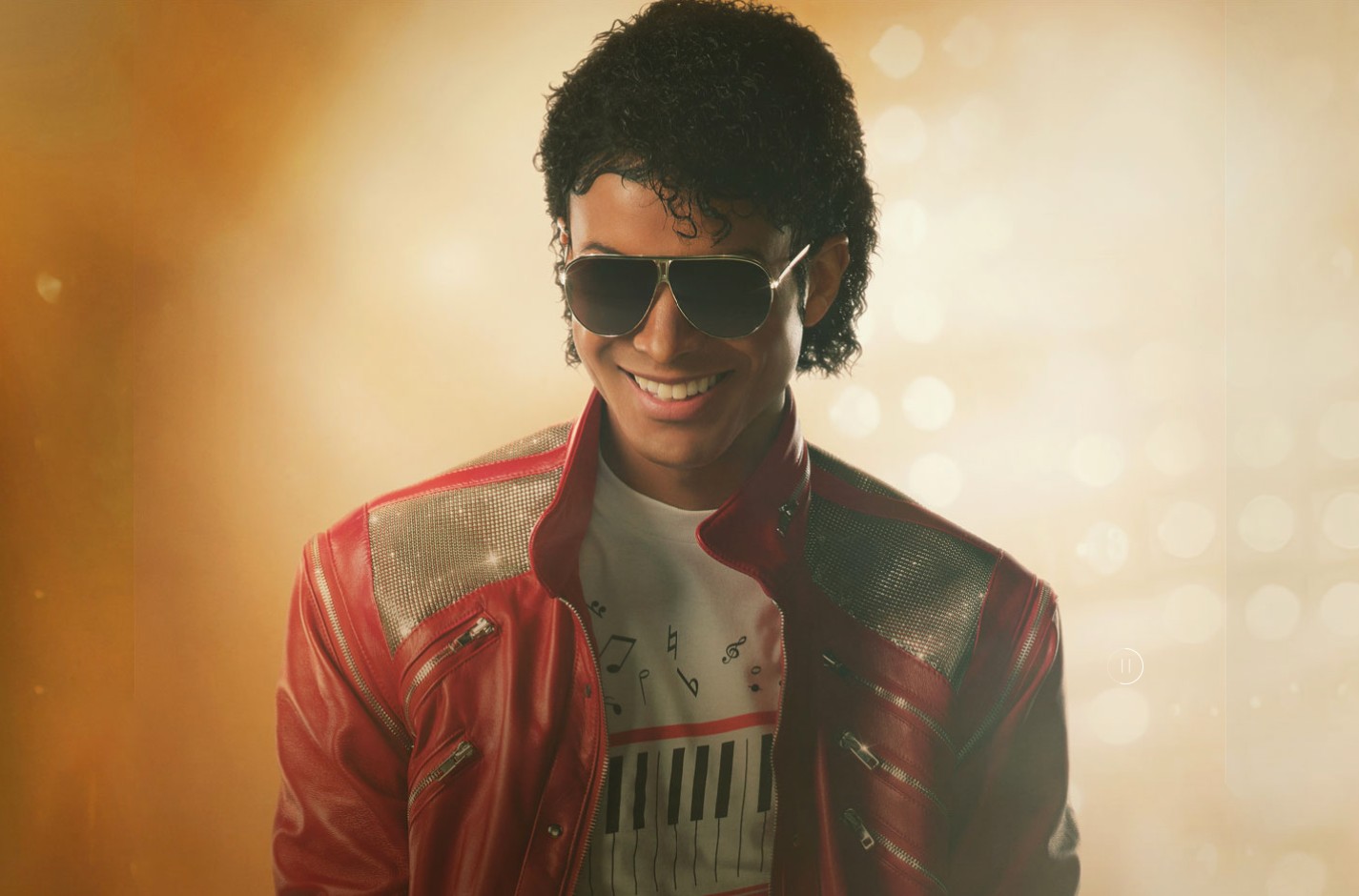
Playing the Legend: Jaafar Jackson as Michael. (Photo Courtesy Michael.Movie)
THE MOVIE: “Michael”
LOCAL SPINS SCORE: ★ ★ (out of four stars)
MPA RATING: PG-13 for some thematic material, language and smoking
CAST: Jaafar Jackson, Colman Domingo, Miles Teller, Nia Long
DIRECTOR: Antoine Fuqua
RUN TIME: 127 minutes (Scroll down for trailer)
REVIEWED BY: John Serba
Support our coverage of
West Michigan's music scene
“Michael” feels more like a pop-cultural hornet’s nest than a movie.
That’s not necessarily an indictment of the film itself; any biopic about Michael Jackson is bound to stir intense emotions and heated discourse.
If you lead with your heart, it’s all about the joy the music brings you. If you lead with your head, the brilliance of the superstar singer’s cross-cultural appeal is blotted out by the many deeply troubling child-molestation allegations brought against him.
As ever, two things can be true at once: “Billie Jean” is an all-time banger, maybe the all-time banger in pop history. And “Billie Jean” was written and performed by someone who by many accounts is a disturbed man.
Right now, the heart seems to be winning in the court of public opinion. “Michael” has been overwhelmingly embraced by audiences (the current international box office tally is a blockbuster $424 million and counting) flocking to theaters for a nostalgic, jukebox-y celebration of Michael’s ’80s classics.
His nephew, Jaafar Jackson, son of Jermaine Jackson, plays Michael, showing an uncanny ability to recreate his uncle’s singular dance moves and voice (the performances are a mixture of Jaafar and Michael’s singing). Directed by Antoine Fuqua (“Training Day”), the film is bookended with recreations of a 1988 London concert from Michael’s first solo tour, and covers roughly two decades of his life, beginning with his childhood success as the precocious lead singer of the Jackson 5.
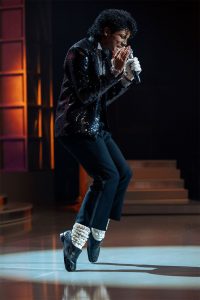
Thrilling Dance Sequences: ‘Michael’ (Courtesy Michael.Movie)
Its primary dramatic arc concerns Michael’s repeated attempts to control his own life and career by shedding the influence of his domineering and abusive father and manager Joseph (Colman Domingo).
So within that framework, the film is a story of Michael’s triumphs – his liberation from oppression and his ability to dazzle millions with his music and artistic vision. It therefore avoids acknowledging the elephant in the room, the first child sexual abuse allegation against him in 1993, as well as the tabloid maelstrom, spurred by his eccentric behavior and subsequent sexual assault lawsuits, in which he existed until his death by a drug overdose in 2009.
Save for whatever unease you might bring to the film, there’s very little here to break the joyous spell of his celebrity and undeniable musical perspicacity.
This is for good reason. Consider the film producer’s dilemma: You face the choice of making a glossy, squeaky-clean farce with the rights to several of the most popular songs ever written, or addressing the allegations in a film about Mickey Jimpson with generic music, that goes direct to Tubi.
Of course, the former happened because you don’t get the music pumping through Dolby sound systems without the blessings of the Jackson family and estate, and it takes only the tiniest logical leap to conclude that “Michael” is an attempt to sanitize his story and reap significant monetary rewards. (It isn’t the first time this has happened either; “MJ – the Musical,” a glorified excuse to cycle through a couple dozen hit songs, launched on Broadway in 2022, earning $317 million and establishing a blueprint for the film to follow.)
So “Michael” essentially enables audiences to exercise their ability to compartmentalize (or, more concerningly, to deny). Contemplating the film within this bubble, it’s a middle-of-the-road biopic that’s a hodgepodge of scenes with visible editing scars and a limp, watery sense of dramatic tension.
It features klutzy dramatic passages and electrifying musical sequences, sometimes jumping from song to song with little, if any dramatic connective tissue. It begs inevitable comparisons to 2018 Queen/Freddie Mercury bio “Bohemian Rhapsody,” which downplayed Mercury’s queerness, distracted us with an exhilarating facsimile of the legendary 1985 Live Aid concert, and scored star Rami Malek an Oscar win.
Jaafar’s performance shows a remarkable talent for impersonation, and hints at potential thespian excellence if he had a screenplay with any interest in psychological depth or complexity.
More extraordinary is Juliano Krue Valdi, vibrant as the young Michael, who can’t stop his feet from dancing while in the recording studio, and gives producer Berry Gordy (Larenz Tate) a long, warm hug because his father preferred to give him the belt.
As the nasty Joseph, Domingo wears facial prosthetics and is forced into a cartoonish villain performance: The character can’t, or won’t, comprehend the cause and effect of beating eight-year-old Michael for not getting a song perfectly right, and being fired by fax via older Michael and his lawyer, John Branca (Miles Teller, in an odd, thankless supporting role).
Meanwhile, Nia Long is asked to simplify the role of Michael’s mother, Katherine, to one or two notes – she nurtures her son but stands by as her husband terrorizes him.
Fuqua guides us through multiple musical montages, pointless recreations of the “Thriller” video and Motown 25 performance of “Billie Jean,” and a beyond-goofy sequence in which Michael recruits L.A. gang members to dance in the “Beat It” video. In between, Michael engages in the bizarre behavior that pads his legend as a man denied a childhood: Getting plastic surgery, obsessively reading “Peter Pan” and quenching his loneliness by adopting exotic animals.
This includes bizarre scenes in which he first meets his famous chimp pet Bubbles, rendered with CGI, and later plays Twister with the ape when his brothers say, ‘No.’ We’re also subject to multiple heavy-handed moments when sweet, innocent Michael visits children in burn and cancer wards and signs autographs for a throng of young fans in a toy store – a glaring, icky instance of They Doth Protest Too Much.
REMINISCENCE, SKEPTICISM, SEPARATING ART FROM THE ARTIST?
The story of “Michael”’s making threatens to invoke film critic Gene Siskel’s baseline for quality: Is the movie more interesting than a documentary of the same actors having lunch? The original version of the screenplay reportedly addressed some of the allegations against him, until the Jackson estate discovered a clause in the legal settlement with accuser Jordan Chandler stating that Chandler could never be depicted in a movie.
So, the film underwent significant edits and reshoots, although it doesn’t require much of a logical leap to conclude that it would’ve likely painted any and all accusers as greedy so-and-sos attempting a shakedown, rather than offering a more nuanced portrayal of real life events.
Notably, Michael Jackson has been accused of sexual abuse by upwards of 10 people, including the subjects of 2019 documentary “Leaving Neverland” (which the Jackson estate recently got HBO to remove from its streaming service) and four members of the Cascio family, who filed suit in February 2026. The testimonies against Michael are convincing, the sheer number of complaints increasingly hard to ignore.
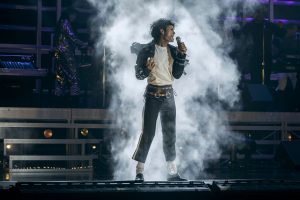
On Stage: Jaafar as Michael (Courtesy Michael.Movie)
Biopics inevitably prompt us to wrestle with accuracy and reasons to stray from it. Sometimes it’s purely narrative – say, streamlining a convoluted plot line for the sake of clarity or pacing – but in this case it feels more insidious.
“Michael” is almost certainly how his estate would prefer we remember the King of Pop as it pushes harder and harder against ugly real-life narratives, and audiences sure seem willing to oblige it. And while I understand the desire to emphasize the light over darkness, this isn’t how we should remember him.
A Michael Jackson retrospective inevitably prompts reminiscence from people of my generation: I used to come home every day from fourth grade and put “Thriller,” the first record I ever owned, on my turntable, or watch MTV for hours and hours hoping to see one of his groundbreaking videos.
So I admit my susceptibility, but it doesn’t outweigh my skepticism. As I sat in the theater scrutinizing the film’s disinterest in interrogating any complexities of Michael’s character, and feeling the involuntary thrill of goosebumps up my arms during the musical performances, I realized that “Michael” is where the waves of nostalgia smash upon some pretty jagged rocks.
The age-old argument about separating the art from the artist is at the heart of the film, and that’s a thorny, nuanced and nigh-impossible argument: Ask 1,000 people and you’ll get 1,000 different answers. Cognitive dissonance rarely gets so dissonant.
VIDEO TRAILER: “Michael”
Copyright 2026, Spins on Music LLC